


The Trial of Standing Bear
16-minute read
Introduction
Imagine living in 1875 in a small but beautiful part of the country between the Niobrara and Missouri Rivers. Just to the south, the new state of Nebraska is less than 10 years old.
For years, you have been moved from one place to another. Then a United States government Indian Agent informs you that you have to move again. You will travel for months, over 500 miles, where the government has promised you will find shelter, food, and housing. When you arrive, you find that no land has been set aside upon which you can permanently settle.
This is the story of a remarkable Native American man and the tribe he was a member and leader of. It is a story that challenged and changed the U.S. legal system and created massive national and international interest. The Ponca Indians and Standing Bear were key participants in a landmark Federal court case held in Omaha in 1879. Standing Bear v. Crook was a small first step by American Indians to achieve limited justice under the U.S. Constitution.
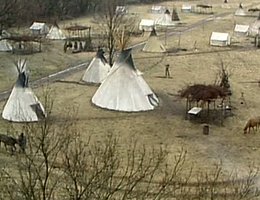
A re-creation of a Ponca village
From the 1988 NET Television production of The Trial of Standing Bear
The Story of the Ponca
The Ponca and Omaha tribes split from other tribes of the Siouan language group sometime prior to 1500. According to tradition, the Omaha and Ponca left their home East of the Mississippi River, followed the Des Moines River to its headwaters and then moved northeast.
By 1789 the Ponca had separated from the Omaha and were living on lands where the Niobrara flows into the Missouri in what is now Nebraska. Lewis and Clark estimated that they numbered only 200 people in 1804. Between 1800 and 1900, they probably never numbered more than 800.
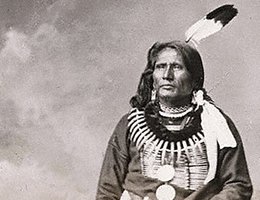
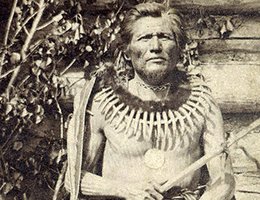
Ma-chu-nah-zah, also known as Standing Bear, was born on the Ponca reservation around 1829. Because he showed unusual abilities, he became a chief at an early age.
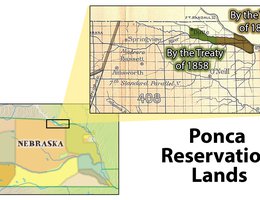
The lands reserved for the Ponca by the Treaties of 1858 and 1865. All of this land was mistakenly given to the Sioux in the Fort Laramie Treaty of 1868.
More on treaties with other tribes.NET Learning Services
Broken Promises
The Ponca Tribe signed several treaties with the federal government from 1817 to 1865. Like other tribes in Nebraska, they were forced to witness the shrinking of their homelands until most were moved to the Indian Territory in the present-day state of Oklahoma.
In 1858, the Ponca ceded a large section of land to the U.S. Government, and agreed to move to a smaller reserved area within one year. In return, they were to receive from the U.S. Government:
- Annuities — cash payments — for 30 years
- Educational institutions for ten years
- A mill to grind grain and one to saw timber
- An interpreter, a miller, a mill engineer, and a farmer
As the Commissioner for Indian Affairs explained in his 1858 Report, the objective was to "colonize and domesticate" the Ponca.
The Ponca planned to give up hunting for an agricultural economy. However, they faced a variety of problems: failure of the government to live up to its promises, drought, locusts, and conflicts with the Sioux. Yet, the Ponca kept their promises and never stole from nor attacked the White man.
In an 1865 treaty, the Ponca gave up most of its 1858 reservation in exchange for lands surrounding them south of the Niobarara River and Ponca Creek. This treaty provided for a reservation of 96,000 acres in the present-day Nebraska counties of Knox and Boyd. The treaty stated that the reasons for this move were to return to the Ponca their traditional agricultural lands and old burial grounds and away from the Sioux who were attacking from the west.
Unfortunately for the Ponca, the U.S. Government signed a treaty in 1868 with the various bands of the Sioux Nation. The Fort Laramie Treaty created a large Sioux reservation that included most of South Dakota west of the Missouri River. Most likely because the Treaty commissioners had forgotten about the provisions of the 1865 treaty, the southern boundary of the Sioux reservation also ran through the land reserved for the Ponca. Consequently, almost all of the Ponca reservation was given to the Sioux.
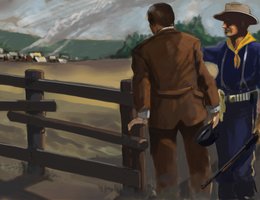
Illustration of Thomas Tibbles at Fort Omaha when Standing Bear was detained
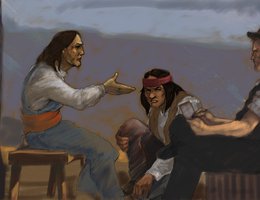
Thomas Tibbles interviewing Standing Bear at Fort Omaha
The Ponca Trail of Tears
The Ponca continued to suffer from attacks by the Sioux, terrible weather conditions, and lack of financial support from the U.S. Government. In 1875, A.J. Carrier, the Bureau of Indian Affairs agent assigned to the Ponca, visited President Grant about moving the Ponca to Indian Territory. Grant agreed to the move if the Ponca were willing.
On September 11 and 23, 1875, Carrier met with the Ponca. Standing Bear and some members of the Tribe agreed to move. They requested that a delegation of Ponca chiefs should be allowed to visit the Indian Territory to select a new reservation. Carrier claimed that the agreement represented the unanimous opinion of the Indians present at the meetings. Standing Bear, however, later claimed that there was a misunderstanding, as the Ponca language had no separate word for land in the Indian Territory and that he thought he was agreeing to move to the Omaha Reservation.
On February 2, 1877, Inspector E.C. Kemble, Ponca Agent J. Lawrence, Standing Bear, and nine other Ponca leaders left for the Osage Reservation in Indian Territory to select a site for the new Ponca Reservation. Adequate preparations had not been made for the visit and many of the Osage chiefs were absent when the Ponca arrived. Consequently, no serious business could be conducted and the land shown to the Ponca as possible sites for their reservation were not satisfactory.
Standing Bear and the other tribal leaders informed Kemble they wanted to return home. Kemble furiously refused and called their actions "insubordination.” On February 21, Standing Bear and seven of his fellow chiefs decided to return on their own. It was midwinter, they had to sleep on the open prairie, and they went for days without rations. An agent for the Otoe Reservation in Gage County remarked that the Ponca leaders left bloody footprints in the snow. After a strenuous journey, the Ponca leaders arrived at the Ponca Reservation on April 2, 1877.
Kemble was already back, and he had new orders from Washington — the Ponca were to be moved, using force if necessary, to Indian Territory.
Those Ponca most willing to journey south left with Kemble on April 16. In May, Standing Bear and the remainder of the Tribe started the long journey to Indian Territory, prodded along by the U.S. military. They encountered bad weather almost from the beginning of the trip, and by the time the tribe reached their destination, they were constantly plagued with insects and extreme weather conditions. Nine people died on the journey, including Stand Bear’s daughter, Prairie Flower, who died of tuberculosis and was buried at Milford, Nebraska.
White Buffalo Girl, daughter of Black Elk and Moon Hawk, also died and was buried near Neligh, Nebraska. The people of Neiligh provided a Christian burial for the girl with an oak cross over the gravesite. Black Elk asked that the grave of his daughter be honored, and in 1913 Neligh erected a marble monument. It is still there.
Watch the story of White Buffalo Girl, a Ponca baby who did not survive the Trail of Tears. From the NET Television series, Nebraska Stories
Standing Bear Arrested
Much of the land on the Quapaw Reservation was not suitable for cultivation, and government agents refused to provide adequate farming equipment. Sanitation conditions were deplorable—many died from malaria. Since leaving Nebraska, nearly one-third of the Ponca had died. In January 1879, Standing Bear’s son, Bear Shield, died. The distraught chief decided to return to Nebraska to bury his son. It was another terrible trip, but on March 4, Standing Bear and his followers arrived at the Omaha Reservation.
Standing Bear and his followers left without permission from the federal government. Under the orders of General George Crook of Omaha, they were arrested and escorted to Fort Omaha, where they were to be held prior to returning to Indian Territory. Post Commander, Colonel John H. King, reported that the serious illness among the Ponca and the weak condition of their horses made it impossible to return them to Indian Territory at that time.
The delay worked in Standing Bear’s favor as the situation came to the attention of Thomas Henry Tibbles, the assistant editor of the Omaha Daily Herald. Tibbles said he was informed about the case by the city editor of his newspaper, the Omaha Daily Herald. However, years later—after General Crook’s death—Tibbles indicated that he became involved in the Standing Bear affair through Crook’s intervention. He reported a conversation with Crook in which the General said, "I’ve been forced many times by orders from Washington to do most inhuman things in dealing with the Indians, but now I’m ordered to do a more cruel thing than ever before."

General George Crook
General Crook was one of many Army officers in the American West who were sympathetic to the plight of Indians and opposed policies of the government that seemed intent on moving all Indians to Indian Territory.
As late as 1871, Gen. Crook had written to President Grant and officially expressed his opposition to aspects of government Indian policy. But his feelings did not become public. General Crook interviewed Standing Bear and several of his tribesmen on March 31, 1879, at Fort Omaha. Crook invited Thomas Tibbles to attend the meeting. General Crook asked Standing Bear why he had left the Indian Territory, and Standing Bear replied,
"At last I had only one son left; then he sickened. When he was dying, he asked me to promise him one thing. He begged me to take him, when he was dead, back to our old burying ground by the Swift running Waters, the Niobrara. I promised. When he died, I, and those with me, put his body into a box and then in a wagon, and we started north."
After Standing Bear had spoken, Crook expressed his sympathy with the Ponca but stated that he had a direct order and would have to obey it. "It is . . . a very disagreeable duty."
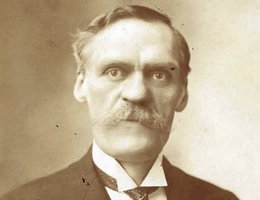
G. M. Lambertson attorney representing the U.S. Government
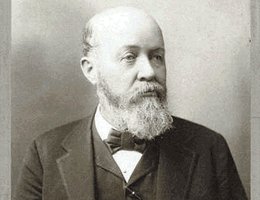
A. J. Poppleton, chief attorney of the Union Pacific Railroad
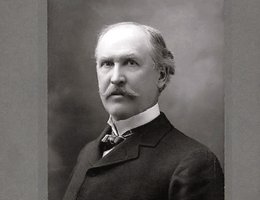
John L. Webster, Omaha lawyer
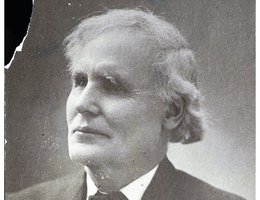
Thomas Tibbles Omaha Herald

An illustration of the courtroom during Standing Bear’s trial
The Trial
While Crook watched over the Ponca at Fort Omaha, Tibbles worked to tell Standing Bear’s story and enlist support for their cause. He telegraphed the story of Crook’s interview with Standing Bear to eastern newspapers and wrote a passionate editorial for the Omaha Herald on April 1, 1879. He enlisted the support of the ministers of the leading churches in Omaha and sent a telegram to Carl Schurz, Secretary of the Interior, pleading with him to reverse his removal order.
Tibbles then roughed out a court case and took it to his friend John L. Webster, a young lawyer in Omaha, and to A. J. Poppleton, the chief attorney of the Union Pacific Railroad. Both agreed to represent Standing Bear and the Ponca without a fee.
The two attorneys then petitioned Judge Elmer S. Dundy of the United States District Court for a writ of habeas corpus to compel General Crook to justify his arrest of the Ponca. Dundy issued the writ and ordered the opposing parties to appear before him.
The trial opened in Omaha on April 30, 1879, and lasted for two days. G. M. Lambertson represented the U.S. Government, arguing that the Indian was neither a person nor a citizen within the meaning of the law and therefore could not bring suit of any kind against the government.
The Ponca's attorney stressed that they had renounced tribal authority, were engaged in farming, had made great advances in assimilation, and were entitled under the provisions of the Fourteenth Amendment to be treated like people. The lawyers also argued that the U.S. Government had no right to take the Ponca’s land or move them to Indian Territory.
After the attorneys presented their arguments, Judge Dundy allowed Standing Bear to address the court through his interpreter, Susette ("Bright Eyes") La Flesche. Standing Bear rose, extending his hand toward the judge’s bench:
"That hand is not the color of yours, but if I pierce it, I shall feel pain. If you pierce your hand, you also feel pain. The blood that will flow from mine will be the same color as yours. I am a man. God made us both."
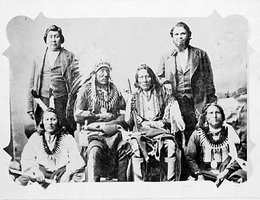
The Decision
After a short trial, Judge Dundy issued a ruling that surprised many observers and caused comment across the country. The judge found that "an Indian is a person within the meaning of the law" and that Standing Bear was being held illegally.
Standing Bear Decision and Release Stories in the Omaha Herald May 1879
For his part, Standing Bear reacted to the decision by going home. But before he left Omaha, he and his party went to the home of his attorney John Webster. The newspaper reported Standing Bear’s farewell:
"You and I are here. Our skins are of different color but God made us both. A little while ago when I was young I was wild. I knew nothing of the ways of the white people . . . For a great many years, a hundred years or more, the white men have been driving us about. . . But since I have been here I have found them different. They have all treated me different. They have all treated me very kindly. I am very thankful for it. Hitherto when we have been wronged we went to war. To assert our rights and avenge our wrongs we took the tomahawk. We had no law to punish those who did wrong, so we took our tomahawks and went to kill . . . But you have found a better way. You have gone into court for us and I find our wrongs can be righted there. Now I have no more use for the tomahawk. I want to lay it down forever."
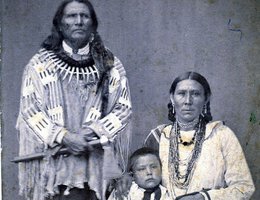
Standing Bear and his family; 1903, several years after the trial
Courtesy History Nebraska, RG2608-1265
Standing Bear’s Legacy
Judge Dundy’s decision in Standing Bear vs. Crook was an important development in the history of Indian-white relations. It established for the first time that Indians were people under the law, not to be regulated by the Interior Department as they pleased. Standing Bear and his followers were free, but to do what and go where?
They had no place to live, nor food to eat, nor clothing to wear. The United States government was still permitted to arrest any Indians who, without permission from the government, were present on reservations not their own. It appeared Standing Bear was only free to return to Indian Territory.
Reactions to the Verdict in the Standing Bear Trial Stories in the Omaha Herald May 1879
Big Snake, Standing Bear’s brother, was denied permission to leave Ponca lands in Indian Territory to visit the nearby Cheyenne, but he went anyway. He argued that his brother’s court case gave him the right to do so. The Ponca Indian Agent convinced the federal authorities to authorize the arrest of Big Snake when he returned. When the army personnel attempted to arrest him, Big Snake physically resisted and was shot and killed in the altercation. His failure to successfully defy federal authority based on Standing Bear’s court victory greatly dampened the enthusiasm of other Indians to attempt it.
A year after Standing Bear v. Crook, Judge Dundy decided in a separate case that the Ponca still held title to their Dakota lands. In 1881, Congress appropriated money to compensate them for their losses from the Fort Laramie Treaty. Five months later the Sioux gave up their claims to the Niobrara country. In 1890, the Ponca were given individual land allotments either in Indian Territory or along the Niobrara. A majority of the Ponca chose to live in the Indian Territory where they had become reconciled to living. However, Standing Bear and his followers chose to live on land that was located on their old reservation. The Ponca choosing to remain in the Indian Territory became known as either the Southern or Hot-Country Ponca. Standing Bear and his followers were known by various names: the Northern, Cold-Country, and Nebraska Ponca.
It would not be until 1924 that Congress adopted the Citizenship Act, which confers citizenship on all American Indians.
Updated October 20, 2026