
The first recorded contact between Europeans and native people on the Central Plains came between the Spanish and the Wichita tribe in what is now Kansas. Contact with the French and the British came decades later. Contact with the Americans came a century or more later still. Very slowly at first, but inexorably, these contacts would change the lives of native people.
Christopher Columbus landed on an island in the Caribbean in 1492 CE. Within a few decades, Spain had begun to conquer many of the peoples of the Western Hemisphere and to establish Spanish settlements. Spanish traders and soldiers gradually moved northward. Commerce became the common language between Native Americans and Europeans.
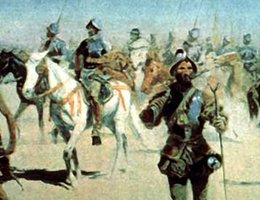
Around 1540, the Spanish sent Francisco Vásquez de Coronado to put down an uprising in New Mexico. He did and took up residence with 230 soldiers and 800 servants among the Pueblo Indian tribes. That year, a Spaniard attacked a Native American woman. Coronado refused to punish him, and the Indians retaliated by stealing horses. Punishment was swift as 200 men were burned at the stake, but this may be the first time native people obtained horses.
At least one historian suggests that the Pueblo Indians may have repeated stories of fabulous cities of gold to the east in order to entice the Spanish to leave. Quivira was the name of this fabulous kingdom, where even the poorest people ate from plates made of gold. Whatever the motive, Coronado believed the stories, and in 1541 launched an expedition into the Plains. Unfortunately for the Pueblos, he only took 40 conquistadors with him.
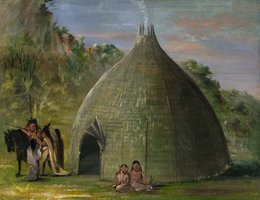
Coronado’s flying column reached where they thought "Quivira" was when they reached central Kansas. They found no gold. Instead they found villages of the Wichita tribe. The Wichitas lived in fascinating conical houses made of poles and grass. They had an economy based on gardening and hunting very much like the Pawnee. In fact, a delegation of Indians from the province of Harahey further to the east visited Coronado at the Wichita village. They were related to the Wichita and were probably Pawnee. So, stories about these new European visitors probably circulated through the plains tribes as early as the 1540s.
After strangling the scout who had told him the tales of gold, Coronado returned in humiliation to Mexico. But for the next 250 years, Spanish explorers would search for the treasure they thought Coronado had missed. The Spanish also sought trade with native people — including trade in slaves, buffalo robes, dried meat, and leather in exchange for horses, sword blades for lances, wool blankets, horse gear, turquoise, and agricultural products, especially dried pumpkin, corn, and bread.
When, in 1578, the British sea dog Sir Francis Drake raided and claimed the Pacific coast, the Spanish were convinced that he had found the fabled Northwest Passage across the continent. That would open trade routes to East India. In response, the Spanish established the first permanent settlements and forts at Sante Fe, New Mexico, in 1598. Individual French traders began exploring and trading on the Plains in the late 1600s. The first recorded European exploration of what would become Nebraska was the expedition of Frenchman Étienne Veniard de Bourgmont in 1714. On the other hand, the first Native Nebraskan to see Europe many have been an Oto man who was willingly taken to meet the King of France in 1725. By that time, even the American colonies on the Atlantic coast were sending trading parties west.
These trading forays made the Spanish nervous, and the next century saw a series of tentative attempts to conquer the vast territory of the Central Plains. That proved to be a daunting task, but the effort had profound effects on the people already living here.
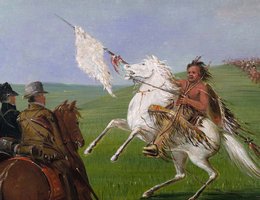
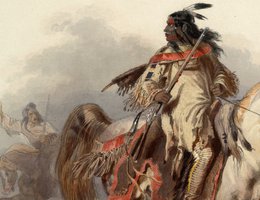
The Spanish offered many wonderful things that Native Americans found useful or beautiful — iron for tools, weapons, glass beads, mass-produced pottery — but the most prized possession of many Indians was the horse.
In ancient North America, horses had become extinct, probably around 10,000 years ago. Meanwhile across the sea, horses were becoming common in many ancient civilizations and were establishing their place in human history. Around 3,000 years ago, horses were tamed in Europe for the first time and used for transportation of both humans and cargo. Five hundred years later, Persian officials began using mounted messengers.
Soon after they arrived in America, the Spanish reintroduced horses to the continent. The Spanish horses were from the finest strains and were regarded as the top breed in Europe. Plains Indians prized them. Stallions and mares that escaped from the Spanish started the great herds of wild horses that spread north from Mexico into the United States and the western Plains country. These herds of wild horses still exist.
Life on the Plains before horses returned was very different. The introduction of horses into plains native tribes changed entire cultures. Some tribes abandoned a quiet, inactive life style to become horse nomads in less than a generation. Hunting became more important for most tribes as ranges were expanded. More frequent contact with distant tribes made competition and warfare more likely. Eventually, in most tribes a person’s wealth was measured in horses, and great honors came to those who could capture them from an enemy.
Before horses, dogs were the only pack animals on the plains. The harnesses and equipment originally designed for dogs were easily adapted to horses. Obviously, horses could carry much larger loads than a dog.
Horses reached Nebraska by the 1680s and the upper Missouri by the 1750s. Tribes in eastern Nebraska (Pawnee, Ponca, Omaha, and Oto) used horses for buffalo hunts, but continued to grow maize and live in earth lodge villages. In the western part of the state, the Sioux, Cheyenne, and Arapaho lived in skin tepees and roamed over most of western Nebraska as nomadic hunters. Horses allowed them to expand their traditional nomadic lifestyle across the plains.
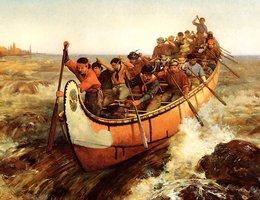
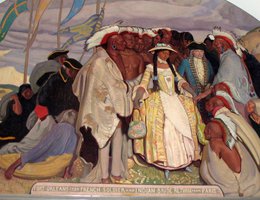
In 1714, a French explorer with a long name — Étienne de Veniard, Sieur de Bourgmont — reached the mouth of the Platte. He named it the "Nebraskier River," using an Oto word that means "flat water." Bourgmont had been in North America for 27 years and was a remarkable soldier, trader, and explorer. When he reached the Missouri territory he married a Missouria Indian woman and lived with the tribe. While living with them, he began to carefully explore the Missouri River and record his observations. It was on one of these trips that he reached the mouth of the Platte.
In 1724, he was sent to create peace treaties among and between the plains tribes. The goal was to secure the expanding fur trade for the French.
All of the chiefs of these tribes replied: "Yes, my father, we will keep our word, and we have no other wish than yours. Our only grievance is to see ourselves so far away from the French, for we often lack merchandise, especially gunpowder and balls."
M. de Bourgmont replied: "My friends, I shall send Frenchmen to your villages to bring you some."
They answered: "That is good, for we have many peltries, especially beaver. We will trade them with your people. They will be very pleased and so will we."
By the early 1700s Spain claimed the southwestern regions of what would become the United States. Britain had claimed all of North America in 1497 and had colonies in the east and Canada. France controlled the area along the Mississippi River. In the west, no boundary had been drawn between the claims of Spain and France. There were many land disputes. The Spanish government felt that trade across the continent should be conducted only by its citizens. None of the profits would go to other countries. The French and the British did not agree.
The French moved on to the Plains via the Mississippi, Arkansas and Missouri rivers to take advantage of the expanding fur trade. They opened regular trade with the Indians of the central Missouri River basin (including Nebraska) by 1703. They concluded treaties of peace and friendship with the Missouri River tribes. French presents and trade goods flowed up the Missouri and overland from the Great Lakes to the tribes in Nebraska.
The French supplied guns and steel weapons, which gave the Pawnee, Osage, Missouria, Kansa, and Wichita great military advantage over their enemies, the Apache. However, the Spanish did not have enough firearms to supply their own people, and prohibited gun sales to all Plains tribes. That put them at a disadvantage against the French and British.
Éttienne de Veniard, sieur de Bourgmont was the first known white man to systematically explore the Missouri River basin and was the first to record his findings. After leaving France a convicted juvenile delinquent, Bourgmont settled in Canada and joined the military. When an Indian attack on Fort Pontchartrain (near modern day Detroit) damaged Bourgmont’s reputation, the acting commander escaped to the wilderness. He lived with Indians for years at a time and became a notorious and powerful figure among the them, eventually becoming the king’s personal envoy to the tribes that complicated France’s desire for western expansion.
The 1724 Journal of Ettienne de Veniard sieur de Bourgmont journal entries chronicle Bourgmont’s expedition to negotiate peace between and among the French, Pawnee, Oto, Kansa, and Padouca (or Plains Apache) Native American tribes.

