
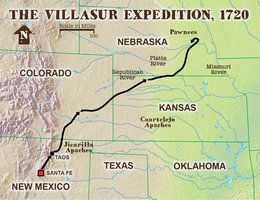
In the early 1700s, Spain claimed as their exclusive territory most of the Central Plains including Nebraska. They were very concerned with protecting their rights to what they saw as a potentially enormous trade with the Native Americans on the plains. But it had been a Frenchman, Bourgmont, who had reached the Platte first and who named it. And the Spanish in New Mexico were seeing more and more evidence of French trade with tribes like the Apache, who traveled north and south along the plains. In 1719 war broke out between France and Spain, and the government in New Mexico decided they had to counter French incursions into Nebraska.
Lieutenant-General Pedro de Villasur (pronounced vee-yah-SOOR) was appointed by Governor Valverde of New Mexico to lead a Spanish army into Nebraska and find out what the French were doing. Villasur had been in New Mexico a number of years and had acted as Valverde’s Lieutenant-Governor in 1719. He was undoubtedly a good administrator but had little military experience. He assembled approximately 40 soldiers and 60 to 70 Indian allies who were excellent skirmishers. He also recruited a dozen or so Apache to serve as guides. The Apache had been mauled by the Pawnee the previous year and were spoiling for revenge. The precise route that Villasur choose is unknown, but it apparently followed a hunting and raiding trail used by the Pawnee.
Joseph Naranjo (pronounced Nah-RAHN-ho) was one of Villasur’s principle aides. He was the son of an African father and Hopi Indian mother and was an experienced, skillful, and fearless explorer. By 1714, Naranjo apparently had made at least three trips to the Platte River area of Nebraska. The viceroy in Mexico City was so impressed that he ordered the governor of New Mexico to confer upon Naranjo the title "Captain of War." Naranjo acted as a scout, interpreter, and guide. He was also in charge of the Indian allies who assisted the Spanish forces.
Villasur’s expedition also included a trader who probably anticipated commercial opportunities on the trip because he loaded down six pack animals with trade goods. One Catholic priest, Father Fray Juan Minguez (pronounced MEEN-gase), also accompanied the expedition.
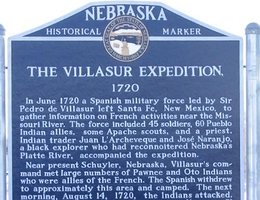
On the morning of June 16th, 1720, Villasur's expedition left Santa Fe. His main objective was to capture French fur traders who had entered Spanish territory illegally and discover their plans. His expedition was one of the most intriguing and disastrous events in our early history.
In August 1720, Villasur’s army arrived at the Platte River somewhere around Grand Island. The troops crossed the Platte and then the Loup River where Villasur started encountering Oto and Pawnee Indians. He attempted to negotiate with them at various times using a Spanish slave who was a Pawnee named Francisco Sistaca. Near present-day Schuyler, Nebraska, Sistaca disappeared. Villasur became very nervous about the belligerence and numbers of the local Indians, whose villages were south of the Platte, near present-day Bellwood and Linwood. So, his army turned around and returned to the Loup River. They crossed the river and set up a camp in a meadow covered with very tall grass, probably located just south of modern-day Columbus, Nebraska.
At dawn on August 14, 1720, a huge force of Indian warriors, possibly accompanied by French traders, attacked the camp. Most of the Spanish were still asleep and the tall grass made it easy for the Pawnee to slip in close. There is speculation that Sistaca had informed his people (the Pawnee) of the best time to attack.
General Villasur was killed in the first attack. The soldiers around him who were still alive formed in a circle. There were other Spanish soldiers who were holding the horses nearby. They were also under attack, but they managed to saddle some of the horses and three of the men charged through the enemy forces towards the circle of troops. One of the three men who made the charge was successful in reaching the circle and seven soldiers escaped via horseback. One of these survivors had been shot nine times and had already been scalped. The Pueblo scouts with Villasur were in a separate camp and did not suffer the full brunt of the attack by the Pawnee and Oto. Still, 11 of them died in the fighting.
The battle lasted for only a few minutes and when it was over, 35 Spaniards were dead, including Villasur, the priest Minguez, Naranjo, one civilian, one lieutenant, one corporal, the quartermaster, and eight soldiers. Forty-nine Pueblo Indians and all of the Apache escaped. The battle was a massacre.
The survivors retreated to Santa Fe and reached home on September 6, 1720, 24 days after the battle. Some of the survivors blamed the French fur traders for their defeat.
This battle was the biggest defeat for Europeans in Nebraska to that time and the biggest victory for Native Americans. It was a major reversal for the Spanish. The governors in New Mexico investigated who was to blame for the defeat for the next seven years.
Meanwhile, the French in present-day Illinois learned of the defeat in October and sensationalized the victory by their Indian allies. The Native Americans brought Spanish swords, guns, clothing, and even part of Villasur’s diary from the battlefield.
No doubt the Spanish defeat had a major demoralizing effect upon the Spanish forces in New Mexico. The province had lost a general, its finest scout, a priest, and some of its best frontiersmen. Officials in New Mexico feared an invasion by the French. The defeat of Villasur’s elite army was followed by a series visits from Frenchmen in New Mexico territory who were seeking trade with the Indians and fueling the Spanish hysteria. However, the French had little success in establishing trade in the New Mexico and eventually gave up their effort. After that, they relied upon Indians to act as middlemen.
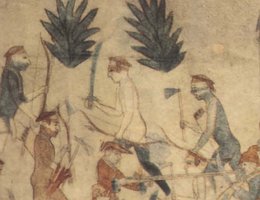
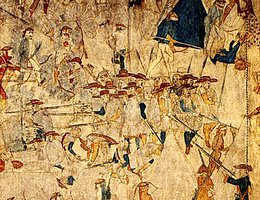
There is a remarkable record of Villasur’s defeat in 1720 still in existence. An unknown artist recorded the battle scene on three large buffalo hides based on descriptions provided by the survivors of the defeat. The artist was expertly trained in the Spanish style of painting, but we don’t know if he or she was Spanish or Indian. Scenes were first drawn in pencil, then traced in ink, and later the intense watercolors were added on a yellow ground.
The original painting still exists. It has hung at the family estate of a Swiss nobleman, Baron Dr. Andre von Segesser, for over 200 years. It is the oldest known painting of a Nebraska scene.
A replica of the hide painting is on display at the Nebraska State Historical Society Museum. The replica is painted on six cowhides stitched together. When you view the reproduction of the painting, you are looking to the south at the forks of the Loup and the Platte. The Platte River is near the top of the painting. Two Indians are wading across the Loup River.
The Pawnee and Oto attackers can be identified by their vivid body paintings and skull caps with drooping tassels. Pawnee warriors were known, in later times, to strip themselves of clothing before a battle. In addition to their bows, arrows, and spears, many are shown armed with swords and hatchets received from French traders.
There are French attackers in the painting, and they are all wearing either three cornered hats or pointed caps. Their similar equipment and clothing styles suggest a military unit, but this may have been artistic license to help explain the Spanish defeat.
The Spanish had built a defensive perimeter of saddles and baggage before the battle, but it may not have been manned when the surprise attack took place. Frenchmen are shown firing from behind the Spanish defenses.
One figure is believed to be Jose Naranjo, a black man who served as chief scout for this and earlier expeditions. He died in the battle.
Pedro de Villasur can be identified by his red officer’s coat. He died of wounds received early in the battle.
Spanish soldiers wore broad brimmed leather hats, long leather coats, and some carried heavy leather shields. They are grouped together in a final defensive circle. The extremely long guns are an exaggeration by the artist, though French muskets were longer than those of the Spanish. The orange flame is the gunpowder’s "flash in the pan."
Father Juan Minguez, a Dominican priest, is shown giving last rites to his fallen comrades. He died in the battle, as well, but for several years rumors circulated that he was taken prisoner by the Oto and later escaped.

