


High Falutin’ Beef
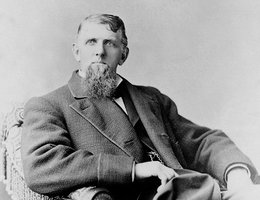
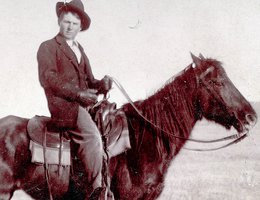
Alexander Swan, Wyoming Rancher, 1831-1905
Courtesy American Heritage Center, University of Wyoming, 160327
Introduction
Several events caused an increase in the number of cattle in Nebraska after the Civil War. The destruction of the Plains bison made more room for cattle, and Native Americans needed a new meat source. Meat-processing plants in Chicago and gold miners rushing to the Black Hills needed beef. The enormous growth in the beef industry caused many changes and challenges.
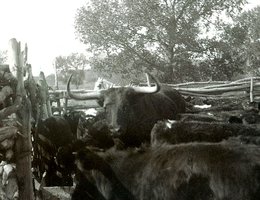
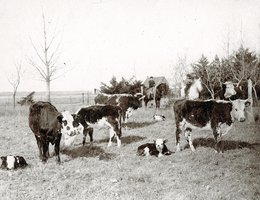
In the 1870s, Americans’ taste for beef became more refined. The Texas Longhorn, the animal that could take care of itself, produced lean and tough meat. Americans wanted the more tender and flavorful meat produced by breeds like Hereford and Angus.
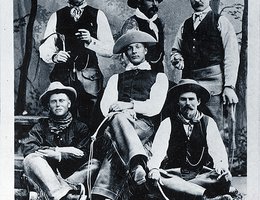
Alexander Hamilton Swan, a Scottish rancher from Wyoming, was one of the first to try to fulfill this new beef preference. Swan was so influential that his admirers acted much like fans of a famous celebrity would today.
From the 2008 NET Television production Beef State
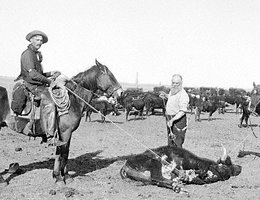
Ephraim Swain Finch branding cattle on the Milldale Ranch near Arnold, Custer County, Nebraska, circa 1900
Courtesy History Nebraska, RG2608-1265
Ranching Styles Change
Enclosing cattle was a big change from the early ranching style in Nebraska. Those who brought cattle north from Texas after the Civil War also brought their ideas of land use which they learned from the Spanish. In Texas, the "ranch" was simply a cluster of buildings. Cattle roamed freely on public land, taking care of themselves.
Cattle were branded so that an individual could identify his animals. Periodically, the rancher would organize a roundup to gather his cattle together and “drive” them to market.
When early ranches were created in western Nebraska, they followed this Spanish-Texan model. Cattle roamed on huge tracts of land. For example, an early Nebraska rancher, John Bratt, had a ranch that extended from North Platte to the Republican River.
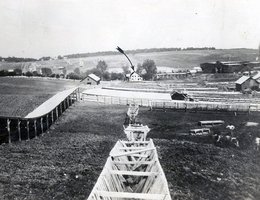
Original Omaha Stockyards, Frank Drexel Farm, 1885. Note: Arrow indicates first Livestock Exchange Building in the old Drexel farmhouse.
Courtesy History Nebraska, RG2608-1265
The Birth of the Stockyards
Ranchers managed to acquire or "borrow" huge tracts of land for their cattle. But many of them noticed that it was a long way to take their cattle to Chicago for meat-processing. In 1882, Alexander Swan came to Omaha and urged business leaders there to consider creating a stockyard. He and others, including Englishman C. R. Schaller, argued that shipping cattle the extra 500 miles to Chicago caused weight loss, and therefore profit loss.
They also noted that Omaha was a transportation center, with the Union Pacific Railroad and the Missouri River. The Missouri provided an adequate water supply and excellent drainage, both necessary for raising stock. Swan noted, too, that there was plenty of corn and grass to fatten the cattle.
In 1884, a group of investors built cattle pens on 10 acres of ground. Then, just two years later, the investors built the Livestock Exchange building. As the stockyards grew quickly, so did the number of animals it processed. Soon meatpackers set up packing plants near the yards. By 1890, South Omaha was the center of an expanding western meat industry. The stockyards and packing plants became essential to the city of Omaha’s economy.
"Up Breeding" Cattle
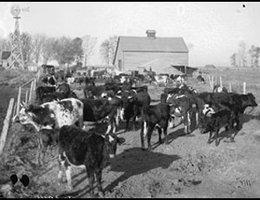
In response to this change in taste, ranchers began to "up breed" their herds. But cattle like Hereford and Angus needed more tending than Longhorns did. They needed hay supplied to them in winter. They needed easy access to water. They often needed help calving, and especially during calving, they needed protection from predators. And there were now thousands of them who needed this special care.
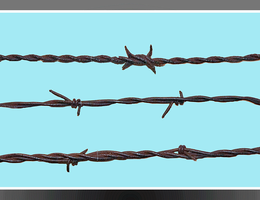
Many ranchers left, but others learned how to provide more protection for these delicate new cattle. Barbed wire and windmills allowed ranchers to control their cattle. Fenced pastures allowed ranchers to manage their grasslands and protect hay meadows. Windmills let them put the water where the cattle were, rather than taking the cattle to where the water was.
Over time, the large free-range ranches became the privately-owned, fenced, and managed ranches we know today.
"Delicate Cattle" describes these new breeds in western Nebraska. Find out how they fared in the Blizzards of 1886 and 1887 that severely affected the beef industry.
From the 2008 NET Television production Beef State
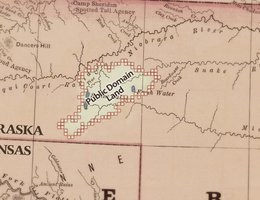
"Donuting" Ranchers bought small pockets of land surrounding public domain land, thus barring access to others and providing exclusive use for themselves
NET Learning Services
Growing Your Ranch
Because of the Blizzards of 1886 & ’87 and other reasons, these large ranches and their owners began to fade from the Nebraska landscape. Bartlett Richards was an exception.
From the 2008 NET Television production Beef State
Although Richards acted as if he lived in Nebraska all by himself, he definitely did not. In the 1870s, more and more people came here to take advantage of the Homestead Act of 1862. They took 160 acre tracts of land and turned them into farms, chopping up the large pieces of government land that cattlemen like Richards had been using to range their cattle.
Life was quite grueling for farmers in Nebraska, a land with a relatively small yearly rainfall. Many homesteaders did not make it, and ranchers took advantage of this fact. From the 2008 NET Television production Beef State
Even though some farmers failed, others kept arriving. As the homesteaders chopped up the vast tracts of public domain land for farms, ranchers faced a dilemma. To profitably raise cattle, you needed more land than the Homestead Act allowed, and cattlemen employed some creative, often devious, tactics to acquire land.
Find out more about the conflict between homesteaders and cattlemen. From the 2008 NET Television production Beef State
Some simply acquired title to tracts of land that would encircle public domain land. They could use trespass laws to keep homesteaders from reaching that land, allowing the cattleman to use the land as if he owned it. Others, like Richards, simply fenced off public land in defiance of the law.
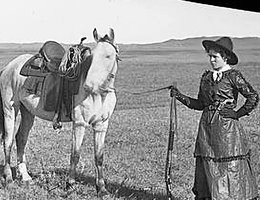
You may have noticed that we’ve been using the term, "cattlemen". That’s because in this time period, the majority of ranchers were men. However, not all. Sadie Austin was a renowned rancher in Cherry County, Nebraska at the end of the 19th century. She rode astride a horse, instead of in the more lady-like side saddle mode, was a crack shot with a gun, and yet, was also a refined musician.
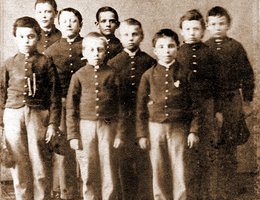
Students at the White Hall Soldiers’ Orphan School, circa 1867
Courtesy Cumberland County Historical Society, Carlisle, Pennsylvania, CV(1)G(11)
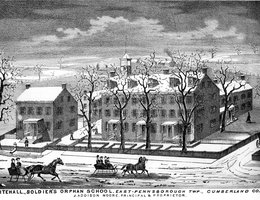
White Hall Orphan’s School; Cumberland County, PA, circa 1867
Courtesy Cumberland County Historical Society, Carlisle, Pennsylvania
Widows & Orphans
Find out more about how these schemers took advantage of widows & orphans.
From the 2008 NET Television production Beef State
The ends to which a rancher might go to acquire land were quite extensive. Some used a provision of the amended Homestead Act that allowed Civil War veterans or their widows and orphans to acquire land. These ranchers would locate war widows and have them file for the land, then get the land from the widow, who often never stepped foot on the property.
In one inventive, if reprehensible, scheme, land speculator John A. Walters of Lincoln took particular advantage of the Homestead benefit. After the Civil War, Pennsylvania Governor Andrew Curtin was moved by the suffering of the children in his war-ravaged state who were left without parents. In response, he created state-funded orphanages and schools for these children, hoping to better their lot in life.
In 1884, John Walters went to White Hall Soldier’s Orphans School in Carlisle, Pennsylvania, and acquired legal guardianship for 21 orphans, all under the age of 13. He then went to Custer County, Nebraska, where he took out homesteads for each of the 21 children. Then, early in the 1890s, all 21 children, represented by Walters, sold their land to Emmet Seybolt and then George A. Seybolt for two dollars an acre. The Seybolts subsequently sold the lands to C. H. Parmele, completing the Parmele Ranch.Read more about:
Some deeds Walters signed, including a list of some of his "guardians".
It would only be later that laws would be passed to prevent the exploitation of children. At the end of the 19th century, what Mr. Walters did was quite legal.