


Roots of Progressivism
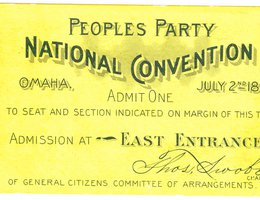
Populist convention ticket, Peoples Party National Convention Omaha, July 2, 1892
Courtesy History Nebraska, RG2608-1265
1870-1900
The beginnings of the Progressive Movement in the 20th Century can be found in the 1870s, ’80s, and ’90s. Even as new settlers were still moving into the state, others were beginning to organize around political and social issues.
Whether women should be allowed to vote became a big issue during the last part of the 1800s. In 1871, voters — who, of course, were all men at the time — were asked if they approved of giving women the right to vote as part of a new constitution for the state. Only 22% said yes, but the suffragettes (women who wanted the right to vote) kept organizing. A newspaper in Hebron, the Hebron Journal, was owned by a strong supporter of suffrage, Erasmus Correll and his wife, Lucy. They wrote regular columns supporting feminist (women’s) causes, and brought the founding mothers of feminism to speak in Hebron in 1877 and 1879.
Other reformers saw alcohol and the saloons as the root of much that was evil in society. Many believed that drinking caused many men to lose their jobs, leave their families and turn to a life of crime. As early as 1886, a political party, the Prohibition Party, was organized in Nebraska and nominated candidates for governor and other statewide offices. Their candidate only got 4.5 percent of the vote, but they continued to organize and agitate.
There was a lot of discontent among farmers and ranchers as well. Periods of drought made growing good crops hard. Prices for agricultural products would dip below what it cost farmers to produce them. Shipping crops and livestock to market on the railroads was expensive. And, even if the land was free through the Homestead Act, farmers and ranchers had to borrow a lot of money to buy their seed, machinery, windmills and buildings.
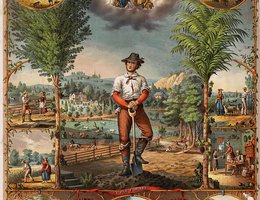
"Gift for the Grangers", detail from a Grange poster showing the ideal of a yeoman farmer, 1873
Courtesy Library of Congress, ppmsca 02956
The Grange
The first of the politically active farmers’ groups was the Grange, or the "Patrons of Husbandry" as they were formally known. The Grange was organized in Nebraska in 1872 with 50 local chapters springing up during that year. Two years later they boasted 20,000 members. The group tended to be stalwart champions of the yeoman farmer. It was said that a Grange member could go to a statewide convention in the big city with a $10 bill in his pocket and the ten commandments in his heart, and he would leave the city without having broken either. Women played equal roles in the local chapters. The chapters tended to put on pageants to dramatize the plight of the farmer.
The Grange tried to reduce the cost of farming by organizing cooperative stores and businesses that could buy in bulk for their members. They even tried to manufacture low cost machinery in Plattsmouth and Fremont. But commercial companies would often sell machinery below cost to drive the Grange businesses out.
The businesses failed, but the Grange did have some political success. In 1876, Grange organizing was able to help push through a provision in the state’s constitution that allowed the government to regulate the railroads. The state now had the power to keep railroad freight rates down to what farmers considered a fair rate. However, it would take decades before the state would act on that power. The Grange declined in members in the early 1880s, although many local chapters still exist.
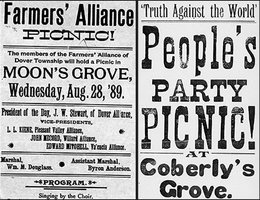
The Populist Party grew directly out of the Farmers’ Alliance. For both groups, social events helped cement political ties
Courtesy Kansas State Historical Society, 00083631, 77585
The Farmers' Alliance
In the 1880s, a new, more radical group attracted new members. The Farmers’ Alliance got off to a slow start. Their second state convention was planned to be held in August, 1882. But it was not well advertised and came in the midst of a harvest season. Only 15 people showed up.
But as hard times developed, the Alliance grew. By 1890, the Alliance claimed 1,500 local chapters and 50,000 members in Nebraska. At that time there were about 500 (mostly weekly) newspapers in the state, and 174 of those were sympathetic to the Alliance’s cause. That year, the Kearney Weekly Hub reported on one of their rallies, saying there were "Just Scads of Them".
Read the story, from the Kearney Weekly Hub
Times were tough. For almost a decade in the 1880s, nature had been kind and the plains produced good crops. But prices kept declining. Many farmers didn’t understand how increasing supplies of goods translated into less demand and lower prices. By 1890, corn prices had dropped to 10 to 20 cents per bushel. Wheat was at 50 cents. Oats were at 15 cents. The Alliance said the problem was the railroads, eastern banks and industrial monopolies. And then a drought hit.
In 1890, the Farmers’ Alliance had become a radical organization facing desperate times. At their convention in the spring, they drafted a Declaration of Principles that supporters were invited to sign. The document called for the government ownership of railroads and telegraph lines, the abolition of land monopoly, the free coinage of silver to inflate the value of crops, and lower taxes so that "our laboring interests will be fostered and wealth bear its just burdens." Within 30 days, 15,000 voters had signed the petition.
At that same convention during the spring of 1890 The Alliance accomplished something even more important — they called for the organization of a new political party at a meeting in July. That convention produced the Populist Party.
When it was established, the Alliance’s constitution had declared they would be non-partisan. But more and more members felt that the old political parties didn’t offer any hope. The Democrats were still the party of the Southern rebels from the Civil War. Democrats were dominated by Catholics and were opposed to prohibition, which many of the Protestant farmers supported. The Republicans, on the other hand, were openly hostile to progressive causes. When it was established, the Alliance’s constitution had declared they would be non-partisan. But more and more members felt that the old political parties didn’t offer any hope. The Democrats were still the party of the Southern rebels from the Civil War. Democrats were dominated by Catholics and were opposed to prohibition, which many of the Protestant farmers supported. The Republicans, on the other hand, were openly hostile to progressive causes.
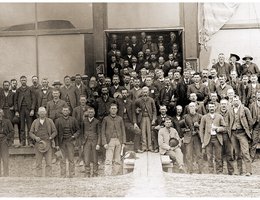
The Independent People’s Party (Populist) Convention at Columbus, Nebraska, where Omer Kem was nominated for Congress, July 15, 1890
Courtesy History Nebraska, RG2608-1265
The Populists
"The Populists didn’t feel that they could get anywhere in their parties.So, they organized their own." — Annabel Beal
Watch this short history of the Populists. From the 1984 NET Television production Plowing Up a Storm
In July, 1890, more than 800 delegates from 69 Nebraska counties met at Bohanan’s Hall in Lincoln. They were there to organize a new political party to advance their ideas into law. They called the group the Populist Party. Their party platform — the policies they advocated for voters — included most of the Farmers’ Alliance platform. The Populists also wanted government ownership of railroads and the telegraph, land reform, free silver coinage and lower taxes. But they also added planks calling for the adoption of a secret ballot in elections, freight rates in law that were no higher than those in Iowa, pensions for old soldiers, an eight-hour work day for laborers (but not for farmers), and an increase in the amount of money in circulation to an equivalent of $50 per person in the country. In July, the Populists met again, this time in Columbus, to nominate candidates.
The People’s Convention nominated a full slate of candidates, including the president of the Farmers’ Alliance, John H. Powers of Trenton, as the Populist candidate for governor of Nebraska. The campaign that followed was exciting. With a withering drought that summer, Alliance orators declared over and over, "We farmers raised no crops, so we’ll just raise hell." A Populist picnic at Cushman Park in Lincoln drew 20,000 people. In the little town of Wymore, 1,050 farmer’s wagons were counted in a Populist parade. That same day in Hastings, 1,600 were counted. Slogans, songs and weekly newspaper coverage pushed the Populist cause.
The state’s old politicians and major daily newspapers, on the other hand, called the Populists "hay seeds," "horny handed sons of toil," "political thugs," and "hogs in the parlor." It didn’t matter.
When the election returns came back in November, 1890, the Republican Party had lost nearly every race for the first time since statehood.
- The Populists had gained clear control of the state Senate, with 18 Populist members, to eight Democrats and seven Republicans.
- The Populists controlled the Nebraska’s House, with 54 Populists, 25 Democrats, and 21 Republicans.
- Not a single Republican had been sent to Congress in Washington. In the first district around Lincoln, a young lawyer named William Jennings Bryan had been elected, despite being given no chance by the pundits. In the second district around Omaha, William A. McKeighan was elected; he was a powerful orator who had been nominated by both the Populists and the Democrats. And in the third district out west, a Populist from Custer County, Omer M. Kem, had been elected.
- The race for governor was very tight. The Democrat, James E Boyd, eked out the win with 71,331 votes. The Populist candidate, John H. Powers was second with 70,187 votes, and the Republican, L. D. Richards, got 68,878 votes.
The governor’s race soon proved to be important. During the legislative session that followed, populists passed a law mandating secret ballots in state elections. They provided free textbooks to schools and passed the state’s first compulsory education law. For the first time, all young Nebraskans were provided a common school education. They passed a public fund deposit law and mutual insurance acts. They passed a law establishing the eight hour day as a legal day’s work, except on the farm, but that law was struck down by the state Supreme Court. One of the major Populist goals was the reduction in railroad freight rates. After an all-out fight in the legislature, a bill cutting rates to those enforced in Iowa finally passed. But Democratic Governor Boyd vetoed the bill. He thought it would bankrupt every railroad in the state since Iowa’s tonnage of goods shipped was four times that in Nebraska. The Populists weren’t able to get the three-fifths majority vote to override the veto.
In 1892, the Populists were full of hope. The party had organized nationally and nominated a candidate for president. In Nebraska, they nominated a more seasoned politician as their candidate for governor, Charles H. Van Wyck. But the Democrats nominated the conservative tree-planter J. Sterling Morton as their candidate, and Morton campaigned primarily against the Populists. As a result, the Republican Lorenzo Crounse was elected governor. Democrat Bryan and Populists McKeigahan and Kem all returned to Congress, but three new seats created by the 1890 Census all went to Republicans. The one bright spot for the Populists was that they were able to re-unite with the Democrats in the state legislature and they elected a Populist judge from Madison County, William V. Allen, to the United States Senate.
In 1894, the "Silver Tongued Orator" William Jennings Bryan changed the political landscape. That year, Bryan became editor of the state’s most powerful Democratic paper, the Omaha World-Herald. A drought had resulted in crop failures for two years. And many farmers were convinced that the only thing that would save them was the free coinage of silver. At the Democratic convention in 1894, Bryan was able to fuse the Democratic Party with the Populist Party. The convention nominated an entire Populist state ticket. The only prominent Democrat on the ticket was Bryan himself, nominated for U.S. Senate. In the election, the Democrat/Populist Silas A. Holcomb won the election for governor. But, the Republicans won almost every other state office. Omer Madison Kem was the only Populist re-elected. And in the state legislature Republicans easily elected a lawyer for the Union Pacific Railroad, John Thurston, to the U.S. Senate. That must have been particularly galling for the Populists.
Holcomb was re-elected governor in 1896 and another Populist, William Poynter, was elected in 1898. The party was able to push through many of their ideas, but they failed to enact their most important proposals. And the party — as an independent third party — was never able to gain complete control of the state government. The party dissolved in 1908. Their biggest influence may have come through their fusion with the Democrats and the launching pad that provided for William Jennings Bryan.