


The 1919 Omaha Riot and Lynching of Will Brown
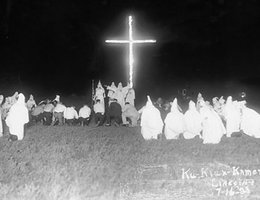
Ku Klux Klan rally outside of Lincoln, Nebraska; July 16, 1923, by L. W. Cook
Courtesy Art Kuhr CollectionNo larger image available.
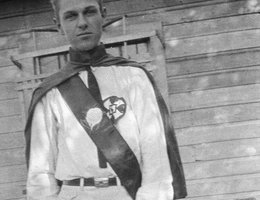
Lincoln man; member of the Ku Klux Klan
Courtesy Art Kuhr Collection
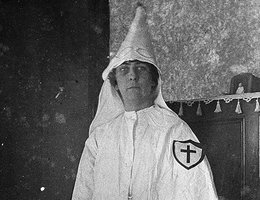
Lincoln woman; member of the Ku Klux Klan
Courtesy Art Kuhr Collection
Racial Tensions in Nebraska after World War I
On November 11, 1918, World War I ended and America emerged victorious. But as thousands of soldiers returned from Europe, they arrived in a country with serious social and political problems that the war had swept under the surface.
There have always been racial divides in America. Tensions come to the surface when one group begins to believe that another group is different from theirs and when established groups feel that their livelihood or way of life is threatened. That was true in 1909 when established European groups in Omaha began to believe that new groups of workers from Greece were a threat. Large numbers of Greeks were moving to Omaha in the early part of the century to work in the packing houses and on the railroads. They settled into South Omaha, which was a separate city at that time. Pretty soon, there were stories in the mainline newspapers about how unsavory the Greeks were.
The Omaha Daily News wrote,
"Their quarters have been unsanitary; they have insulted women. . . Herded together in lodging houses and living cheaply, Greeks are a menace to the American laboring man—just as the Japs, Italians, and other similar laborers are."
In 1909, an Irish South Omaha police officer was killed trying to arrest a Greek man. The Greek was arrested, but a mob formed around the jail. The suspect was almost lynched as police transferred him to an Omaha jail. Two days later, 1,000 men gathered in South Omaha and stormed "Greek Town," looting shops, burning buildings, and beating any Greeks they found. The police and authorities did not respond. In the wake of the riot, almost all of the Greeks living in Omaha moved away.
After World War I, Nebraska (like other states) was experiencing the problems of peacetime readjustment. This was especially true with problems between blacks and whites. Before the war, racial tensions were serious but were most visible in the South. During the war, black Southerners began a mass migration to the North, seeking jobs in the wartime industry boom. When the soldiers returned, tensions increased nationwide. Nebraska, and especially Omaha, was no exception. Although racial clashes had taken place here in the past, they were limited in scope. Now, the tensions boiled to the surface.
After the war, the hate group, the Ku Klux Klan, launched major membership drives across the Midwest. The first Nebraska Klavern was founded in Omaha in 1921. By the end of the year, there were around 24 chapters in the state with an estimated membership of 1,100. By 1923, the Atlanta headquarters of the KKK claimed 45,000 members in the state. The Lincoln Star reported that the Klan was "active in Lincoln, Omaha, Fremont, York, Grand Island, Hastings, North Platte and Scottsbluff".
While political candidates promised a "return to normalcy," the country’s social problems remained unresolved. Racism was on the rise. Ethnic divisions that had come to the surface during the war continued after it. Corrupt city governments and shoddy reporting in the newspapers contributed to the general anxiety of the early post-war years. The summer of 1919 was a time of restless transition, and Omaha was one of the flash points. Violence was just under the surface.
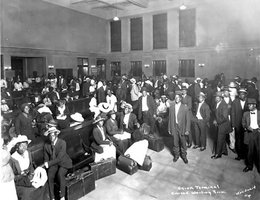
Segregated railroad waiting room at the Union Terminal; Jacksonville, Florida, 1921
Courtesy Florida State Archives, RC09666
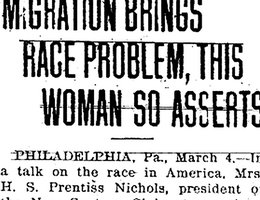
Article in the African American newspaper the "Cleveland Advocate," March 6, 1920. Like many black newspapers, the "Advocate" reported on the great migration.
Courtesy Ohio Historical Society, Vol 6, Issue 43, Page 3
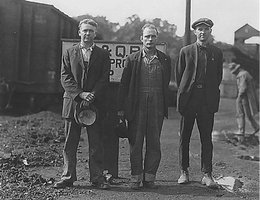
Strikers (photo 1 of 4) at the Burlington Railroad Shop Yards Plattsmouth, Nebraska, 1922. The brotherhood of Railroad Car men and the International Association of Machinists.
Courtesy National Records & Archives Administration, 283732
African American Migration
Between 1910 and 1920, the African American population of Omaha doubled from around 5,000 to 10,315. Those 10,000 blacks made up five percent of Omaha’s population. Blacks made up only around one percent of the population of the state. Even with these small numbers, the rate of growth of the minority population alarmed the white population.
The city’s black newspaper, the Omaha Monitor, was filled with stories of how good it was for blacks in the city. The Monitor and other black newspapers regularly reported on the progress of the migration. They knew this was an historic event.
White newspapers took note as well. During the first week of August 1919, the Omaha Bee reported that as many as "500 Negro workers," mostly from Chicago and East St. Louis, arrived in Omaha looking for work in the packing houses.
When Omaha experienced labor strikes, blacks were hired to replace the striking workers, angering white newspapers and workers.
The Omaha Bee hyped the stories and added to existing racial hostilities.
African Americans were just one ethnic group who migrated in great numbers to northern cities like Omaha, Nebraska in the first years of the new century. From the 1994 NET Television program A Street of Dreams
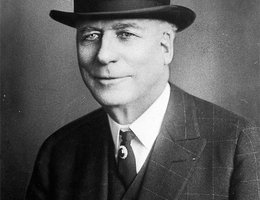
Thomas Dennison; professional gambler, Omaha political machine boss
Courtesy History Nebraska, RG2608-1265
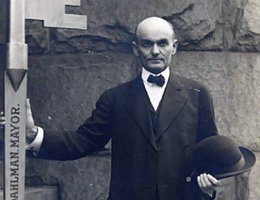
Omaha Mayor James "Cowboy Jim" Dahlman, who some accused of being a front man for Dennison
Courtesy History Nebraska, RG2608-1265
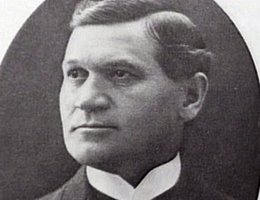
Dennison’s Political Machine
In the first two decades of the 20th Century, Omaha had acquired the reputation of a "wide open" city controlled by Tom Dennison’s political machine. Dennison was a professional gambler who had little education or social standing. To be a gambler in a city where gambling was illegal meant that he needed friends in politics and the police. Dennison bought those friendships through lavish campaign contributions and his ability to get out the vote. His base of operations was in the downtown third ward where he handed out jobs and welfare to residents in need. The third ward included the heart of Omaha’s gambling and prostitution houses. At election time, the ward could be counted on to deliver huge and lopsided vote totals for Dennison’s chosen candidate. One of his most prominent allies was Edward Rosewater, the publisher of the Omaha Bee newspaper. Rosewater was a political fighter, once described as the "best practical politician in Nebraska." He knew Omaha politics as well as any other man. Rosewater was politically ambitious and wanted to exert as much influence as possible on any political decisions made in Omaha. He needed Dennison’s influence over candidates as well as his ability to deliver votes. On the other hand, Dennison needed Rosewater’s social standing and newspaper, so the two men teamed up. Edward Rosewater died at the Omaha Bee building on August 30, 1906. However, Dennison continued an alliance with Edward’s son, Victor, who became the new publisher and editor of the Omaha Bee. Just after World War I, a returning soldier was hired as a cub reporter on the Bee. One day his boss told him to go talk to an Omaha businessman tied to Dennison. The reporter was told to take down whatever the businessman said and to not bother checking the facts. "Mr. Dennison is interested in this story," the reporter was told, "and it is the policy of this paper to print whatever Mr. Dennison . . . wants."
From 1908 through 1918, progressive Omahans had been pushing for reform and were slowly chipping away at Dennison’s political machine. in 1918, the reformers were able to elect Democrat Edward P. Smith as Mayor of Omaha. He was joined by a new police commissioner, J. Dean Ringer, who was determined to purify a sinful city. Smith went after Dennison’s gambling and liquor interests. Dennison and Victor Rosewater were determined to throw out the Smith/Ringer administration.
Dennison’s political machine would do anything it could to disrupt the Smith administration, while Victor Rosewater would resort to yellow journalism to destabilize the reformers. The volatile racial situation in 1919 was the perfect issue for their purposes. Rosewater began to report allegations of black men raping white women and blamed the new reform administration for allowing lawlessness to run rampant.
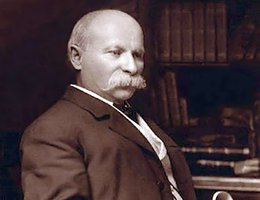
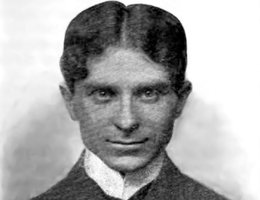
Victor Rosewater (1871-1940), publisher of the "Omaha Bee" after his father’s death in 1906 and a founder of the American Jewish Committee; Photo taken in 1903
Courtesy The Independent, Volume 55, Public Domain
Yellow Journalism
During 1919, Edward Rosewater’s Omaha Bee newspaper published a series of sensational stories of racial incidents that inflamed emotions throughout Omaha. There were lurid stories in the Bee as 21 Omaha women reported that they were assaulted from early June to late September of 1919. Twenty of the victims were white and 16 of the assailants were identified as black.
The World-Herald, the Daily News, and the Monitor were all subdued in their coverage of these incidents. The Bee was not. Its coverage was a good example of what’s known as "yellow journalism" — the practice of reporting sensationalized, exaggerated stories to boost sales. The information reported is usually inaccurate or biased, and the language and tone is intended to arouse passions. The public has little chance to figure out the truth.
The Bee carried vivid descriptions of the arrest of blacks charged in these incidents. When police and prosecutors could not convict any of those arrested, some Omaha citizens became even more critical of the police department and the reform Smith administration. The pro-labor Mediator newspaper warned that vigilante committees would be formed if the "respectable colored population could not purge those from the Negro community who were assaulting white girls."
The Bee sometimes printed editorials on the front page of the newspaper, assailing police commissioner Ringer for practicing tyranny and abuse and complained that "a ‘carnival of crime’ is being visited upon the city, with assaults, robbery, and violence the consequences of incompetent police unable to safeguard citizens."
In early September, the Bee resumed its attack on the city administration following the shooting of a young black bellboy during a police hotel raid. The paper referred to the death of the bellboy as "the ‘crowning achievement’ of the police department reflecting its ‘disgraceful and incompetent management’."
By the late summer of 1919, labor unrest, racial hatred, crime, and government ineptitude fueled by a sensationalist press, had provided the ingredients for crisis in Omaha. Racial violence erupted on September 28, and before it ended, a black man would be lynched, two other people would die, the Douglas County courthouse would be in ruins, and the city would be under federal military control.
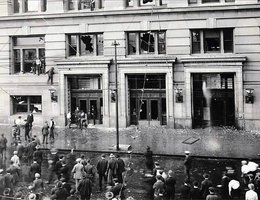
Rioters on the south side of Douglas County Courthouse; Omaha, Nebraska, September 28, 1919
Courtesy History Nebraska, RG2608-1265
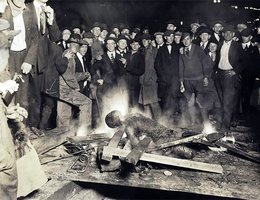
Some of the crowd grinned while watching the burning of Will Brown’s body; Omaha, Nebraska, Sept. 28, 1919
Courtesy History Nebraska, RG2608-1265
A Horrible Lynching
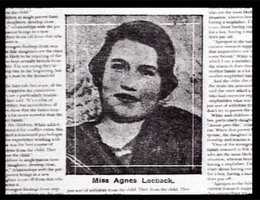
From May through September 1919, over 25 race riots rocked cities from Texas to Illinois, Nebraska to Georgia. In Omaha, the trouble began on September 25, when a white woman, Agnes Loebeck, reported that she was assaulted by a black man.
The next morning, the Bee reached new lows reporting the event. The headline was: "Black Beast First Stick-up Couple."
"The most daring attack on a white woman ever perpetrated in Omaha occurred one block south of Bancroft street near Scenic Avenue in Gibson last night."
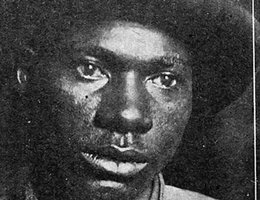
That evening, the police took a suspect to the Loebeck home. Agnes and her boyfriend Milton Hoffman identified a black packinghouse worker named Will Brown as the assailant. Brown was 41 years old and suffered from acute rheumatism.
Before the police could leave the Loebeck house, a mob gathered outside and threatened to seize Brown. After an hour’s confrontation, police reinforcements arrived and Brown was transferred to the Douglas County Courthouse. Several police officers were ordered to report at once to police headquarters in case of further trouble, and 46 policemen and a detective were kept on duty well into the night.
Rumors began to fly that a mob would try to seize Brown again. On Sunday, September 28, a group of youths gathered in South Omaha and began a march to the Douglas County courthouse. Eventually, an estimated 5,000-15,000 angry people gathered at the courthouse and by evening, the Omaha police and city officials inside the courthouse were virtual prisoners. By 8:00 p.m. the mob had begun firing on the courthouse with guns they looted from nearby stores. In that exchange of gunfire, one 16-year-old leader of the mob, and a 34-year-old businessman a block away were killed. By 8:30 the mob had set fire to the building and prevented fire fighters from extinguishing the flames. Inside, Will Brown moaned to Sheriff Mike Clark, "I am innocent, I never did it, my God I am innocent."
The lynching of Will Brown was a horrible event that affected all parts of the city. From the 1994 NET Television program A Street of Dreams
Mayor Smith had been at the scene for several hours. He came out of the courthouse and tried to reason with the mob. He asked them to forget the prisoner and allow the firemen to put out the flames. At that point, the mayor was knocked down by a blow to his head, and the next thing he knew, he was on Harney Street. One end of a rope was being flung over a lamp post. The other end tightened around his neck. That was the last thing he remembered until he woke up in a hospital where he remained for several days in serious condition with severe head injuries.
Mayor Smith had been rescued, but there are several versions of how the rescue happened. Some reports say police detectives were responsible for saving Smith’s life. Others give the credit to a young man named Russell Norgaard. Whatever the true story, the mob lost interest in Smith and concentrated on getting Brown out of the courthouse.
Brown ended up in the hands of the crazed mob. He was beaten into unconsciousness. His clothes were torn off by the time he reached the building’s doors. Then he was dragged to a nearby lamp pole on the south side of the courthouse at 18th and Harney around 11:00 p.m. The mob roared when they saw Brown, and a rope was placed around his neck. Brown was hoisted in the air, his body spinning. He was riddled with bullets. His body was then brought down, tied behind a car, and towed to the intersection of 17th and Dodge. There the body was burned with fuel taken from nearby red danger lamps and fire truck lanterns. Later, pieces of the rope used to lynch Brown were sold for 10 cents each. Finally, Brown’s charred body was dragged through the city’s downtown streets.
Nebraska-born actor Henry Fonda was 14 years old when the lynching happened. His father owned a printing plant across the street from the courthouse. He watched the riot from the second floor window of his father’s shop.
"It was the most horrendous sight I’d ever seen . . . We locked the plant, went downstairs, and drove home in silence. My hands were wet and there were tears in my eyes. All I could think of was that young black man dangling at the end of a rope."
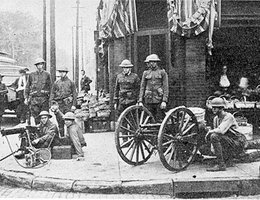
Soldiers on guard at 24th and Lake streets, Omaha, following the 1919 riot
Courtesy History Nebraska, RG2608-1265
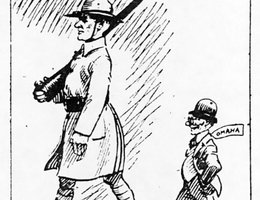
Cartoon implying that only the Army, not local police, could actually protect Omaha; "Omaha Bee", Sept. 30, 1919
Courtesy History Nebraska, RG2608-1265
The Army Restores Order
City and state officials began asking for federal troops to come to Omaha while the riot was still building — as early as 6:20 p.m. on the evening of September 28th, more than four hours before Brown was killed. But, because the requests were directed to both local Army posts, Fort Crook and Fort Omaha, and to the War Department in Washington, the signals were confusing. The Army intervention proceeded slowly at all levels.
Lieutenant Colonel Jacob Wuest, commander of Fort Omaha, was aware of the threatening crowd as early as 5:30 p.m., but he was unwilling to damage his career by intervening in a civil disorder without an explicit order. He was also unsure whether or not it was legal to use troops in a civil disorder.
Local authorities needed to get a specific request for help from civilian officials and a command from higher up. Omaha officials tried to contact the governor, Samuel R. McKelvie, but he was in North Platte and unreachable. President Wilson had suffered a stroke and was unavailable. Finally, they reached Lt. Gov. P. A. Burrows. Burrows who made the request for troops, and Secretary of War Newton D. Baker ordered Wuest to intervene.
When they finally arrived, troops were stationed near the courthouse. But the mob had already departed, dragging Brown’s body behind them. Another company of troops was dispatched to 24th and Lake Streets, in the heart of the black community. They were there to prevent any further murders of black citizens. Orders were issued that any citizen with a gun faced immediate arrest. All blacks were ordered to remain indoors. By nightfall the next day, September 29, the Army reported that Omaha was quiet.
“Frenzied Thousands Join in Orgy of Blood and Fire”
Major General Leonard Wood, Wuest’s commander, returned to Omaha on September 30 and assumed overall command. Troops were concentrated at 24th and Lake Streets, at the courthouse, and at 24th and O streets in South Omaha where many of the rioters had come from. Gen. Wood took command away from civil officials in order to rebuild the law enforcement agencies of Omaha and prevent more violence. He also began an investigation of the riot. The Army began to arrest mob ringleaders on the basis of photographs confiscated from the public. Gen. Wood personally interviewed several suspected mob participants.
Even though photographs identified members of the mob, all of the suspects were eventually released.
After the riot, some wondered if more aggressive action by Colonel Wuest could have prevented the mob from murdering Brown, attempting to murder Mayor Smith, and destroying the courthouse. The Army succeeded in preventing further bloodshed and destruction in Omaha, but more timely intervention might have prevented the violence altogether.