


el-Hajj Malik el-Shabazz (Malcolm X)
15-minute read
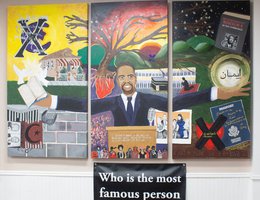
Mural at Malcolm X Memorial Foundation
Photo by Aaron Bonderson | Nebraska Public Media
Introduction
El-Hajj Malik el-Shabazz (widely known as Malcolm X) is one of Nebraska’s most significant historic figures, especially in his birthplace of North Omaha. An orator and human rights advocate, Malcolm X inspired generations of activists to resist racial inequality, police brutality, and dehumanization. He was both celebrated and vilified for his message of Black dignity, piercing analysis of American racial history, and calls for Black communities to defend themselves from violence. Before his assassination in 1965, he helped to connect the Black freedom struggle in the United States to the global human rights movement. Malcolm X became the first Black inductee to the Nebraska Hall of Fame in 2022.
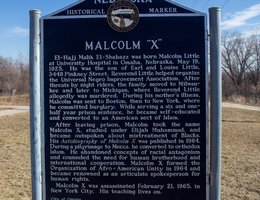
Historic Marker at the Site of Malcolm X's Childhood Home
Photo by Aaron Bonderson | Nebraska Public Media
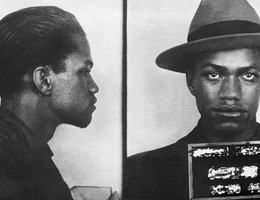
A Mugshot of Malcolm X in 1944
Public Domain Image | Wikimedia Commons
Early Life
Malcolm X was born Malcolm Little in Omaha, Nebraska on May 19, 1925. Malcolm’s father, Earl was from Georgia—he was one of many Black southerners to find a home in Omaha during the Great Migration. Louise Little, Malcolm’s mother, was an immigrant from the island nation of Grenada in the West Indies.
Malcolm’s parents were active in the North Omaha community. They led the local chapter of the Universal Negro Improvement Association (UNIA), founded by the Jamaican American activist Marcus Garvey. As a Black Nationalist, Garvey believed that Black Americans should seek independence in their own communities rather than integration into White society.
The Littles left less than a year after Malcolm's birth to escape harassment and violence. Omaha was one of countless American cities that experienced anti-Black violence and terrorism in the early 20th century—Will Brown had been lynched only six years earlier in one of the most gruesome riots of America’s “Red Summer.” By 1925 the Ku Klux Klan was well-established in the Omaha area, and clashes between the KKK and the UNIA were common.
Malcolm grew up in East Lansing, Michigan, where he experienced more hardship. By the time he was five years old, the United States had fallen into the Great Depression. Poverty and unemployment affected all Americans but were especially tough on Black Americans who faced the added burdens of discrimination and segregation.
Malcolm’s first memories were of his house burning to the ground, likely the result of arson committed by White neighbors. When Malcolm was six, his father was run over by a streetcar—his death was also rumored a murder by White supremacists. As his mother shouldered the responsibility of caring for eight children, her mental health deteriorated. She became withdrawn and neglectful, leaving Malcolm’s older siblings to care for the younger children. Following a nervous breakdown in 1938, she was committed to Michigan’s state psychiatric hospital in Kalamazoo.
In his autobiography, Malcolm X described sensing at a young age that White people saw him as less than human. State social workers regularly visited his home, asking him uncomfortable questions about his family and angering his mother. He was the only Black student in his school, and it went unquestioned that his classmates, teachers, and even friends called him by racial slurs. He stole to feed himself and was often in trouble. His grades plummeted. At age 13, Malcolm was expelled from school and sent to a detention home in Mason, Michigan.
With this dramatic change of environment, Malcolm’s teachers and classmates saw a different side of him. He began to excel in class, went out for sports, and was even elected class president. Despite the constant feeling that he was a “mascot” for his new White caretakers and teachers, he also expressed pride in his successes. However, one conversation would prompt him to give up his academic goals. He confided in a White English teacher that he was considering a career as a lawyer, and the teacher insisted that he think about a more “realistic” career for a Black boy, such as carpentry.
That conversation stuck with Malcolm. He quoted it in his autobiography and in several speeches through his adult life. He learned from that exchange that there was no place for him in school, Michigan, or White America. In 1941, he dropped out of the ninth grade to live with an older half-sister in Boston, Massachusetts. Jobs were easy to find—after the bombing of Pearl Harbor, the draft had pulled many American men into the armed forces, leaving their positions open. Malcolm landed a job in 1943 selling sandwiches on the “Yankee Clipper,” the train line between Boston and New York City. This is how Malcolm first came to Harlem.
New York’s Harlem neighborhood was not thriving as it had been during Malcolm’s childhood in the Roaring 20s. It strained under the weight of racial tensions that burdened dozens of American cities during the Second World War. In Malcolm’s first year there, he witnessed a riot over Robert Bandy, a Black soldier who had been shot and wounded by a White police officer.
Malcolm supported himself any way he could, legally and illegally. He bartended, washed dishes, waited on tables, and emceed at clubs. He also made money racketeering and burglarizing small businesses. For a time, Malcolm traveled up and down the railways of the East Coast selling marijuana to jazz musicians. As his own drug addiction escalated, so did his criminal activities. In 1946, Malcolm returned to Boston where he was arrested for a series of home burglaries and sentenced to eight years in prison.
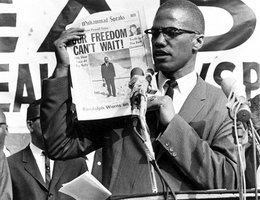
Malcolm X Holding a Copy of the Official NOI Newspaper
Public Domain Image | Wikimedia Commons
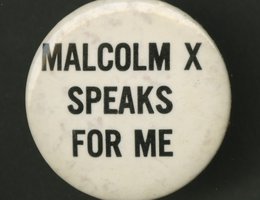
Pinback Button Reading "Malcolm X Speaks for Me"
Smithsonian National Museum of African American History and Culture
The Nation of Islam
Malcolm would serve seven years of his sentence across three different prisons and walk out changed. He quit using drugs and began to take correspondence courses in English and Latin. He spent time in the prison library, reading ancient classics such as the Histories of Herodotus and Aesop’s Fables as well as Black American literature like W.E.B. Du Bois’ The Souls of Black Folk and Harriet Beecher Stowe’s Uncle Tom’s Cabin.
It was in prison that Malcolm was first introduced to the Nation of Islam (NOI), a Black religious organization founded in 1930 and based in Chicago. It was led by Elijah Muhammad, who claimed to be the messenger of God. Despite its name, the NOI is rejected by most Muslims. It is better understood as a new religious movement that combines some elements of Islam with its own mythology. At the core of the Nation's religion is the belief that Black people are the descendants of an ancient and powerful race while Whites are a race of evil “devils.” Malcolm embraced these teachings entirely, though in time he would come to outgrow, and in the eyes of the American public, eclipse them.
Malcolm began exchanging letters with Elijah Mohammad and recruiting fellow inmates. He replaced his last name with “X,” which was commonly used by NOI members to represent the African family names that slave traders had taken from their ancestors. It was during this time that Malcolm earned his first mention in a newspaper by petitioning the prison to make accommodations for Muslims. It was also during this time that the FBI began surveillance on Malcolm X.
Malcolm was released on parole in 1952. He was 27 years old. He traveled to Chicago where he became a rising star in the Nation of Islam and one of Elijah Muhammad's most-trusted representatives. As the lead minister of Temple Number 7 in Harlem, Malcolm recruited tens of thousands of new members and established temples in Boston, Philadelphia, Hartford, and Atlanta.
While Americans saw Dr. Martin Luther King Jr. as the face of the Civil Rights Movement in the South, Malcolm X spoke to the needs and the frustrations of Black Northerners. He appealed to widespread impatience with the slow progress of the Civil Rights Movement. Like Marcus Garvey, he advocated self-sufficiency and self-defense against White violence. Perhaps most importantly, he identified the sense of self-hatred created in Black Americans by generations of racism and encouraged them to love themselves and their communities.
The NOI’s influence grew under Malcolm X’s leadership. In 1957, a Nation member named Hinton Johnson was severely beaten by New York City police. A crowd of thousands, led by Malcolm, surrounded the police precinct and negotiated for Johnson to receive emergency medical care at Harlem Hospital. Though the officers were never indicted for the beating, Malcolm and the NOI later took the NYPD to civil court and won the largest police brutality settlement in the city’s history.
Malcolm’s growing influence brought new attention from the FBI’s Counter-Intelligence Program (COINTELPRO) which began in 1956 with the purpose of monitoring, discrediting, and disrupting organizations that the FBI deemed un-American. The NOI was one of many organizations that were either pro-civil rights, anti-war, feminist, or socialist being monitored and disrupted by the FBI.
Despite increased attention from law enforcement, the NOI remained relatively unknown to the public until the 1959 broadcast of The Hate that Hate Produced, hosted by Mike Wallace on WNAT-TV (now PBS member THIRTEEN). The documentary introduced many Americans to the Nation of Islam for the first time and set it in a sharp negative contrast to civil rights groups like the SCLC and NAACP.
There were real contrasts between Malcolm X and his peers. While the civil rights groups of the South were largely Christian, the Nation had its version of Islam. While Martin Luther King was implementing a philosophy of non-violence, Malcolm X encouraged Black Americans to defend themselves from White violence by any means necessary. While civil rights organizations worked towards the goal of integration, the Nation of Islam carried on the Black Nationalist tradition of independence. Malcolm X embraced and often emphasized these contrasts, publicly criticizing civil rights groups for taking money from White donors and placing White men in positions of leadership.
Malcolm’s appearance in The Hate that Hate Produced catapulted him into public consciousness. Universities across the country began to invite him for speaking engagements. He debated Civil Rights leaders on television and radio, reaching greater audiences. Malcolm X was becoming the face not only of the NOI, but of many Black northerners who questioned the progress of the Civil Rights Movement.
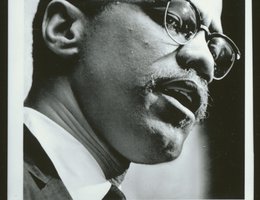
Malcolm X Shown in Omaha on June 30, 1964
Photo by Elmer Kral | History Nebraska
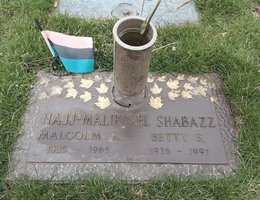
Grave of el-Hajj Malik el-Shabazz and his wife Betty Shabazz
Photo by Jjazz76 | Wikimedia Commons
Split from the NOI and Assassination
As Malcolm X’s notoriety grew throughout the early 1960’s, other high-ranking NOI ministers competed for influence by criticizing Malcolm and sewing distrust. FBI spies fueled this competition by leaking internal disagreements to the press and forging antagonistic letters between the ministers.
Malcolm X was also changing ideologically and drifting away from the Nation’s beliefs. Leaders across the broader Civil Rights and Black Freedom movements had sparked Malcolm’s interest in politics and direct action, concepts the Nation of Islam took no interest in. Like many members of the NOI, Malcolm was also increasingly learning from the global Islamic community and exploring his interest in Sunni Islam: the form of Islam practiced by a vast majority of the world’s Muslims.
By the Spring of 1964, Malcolm had been exiled from the Nation and spent much of the year out of the country. He participated in the Hajj, a religious pilgrimage to the city of Mecca in Saudi Arabia undertaken by almost all Muslims. Malcolm, now signing his name el-Hajj Malik el-Shabazz, returned to the United States transformed. He described his changing attitudes in an open letter:
Never have I witnessed such sincere hospitality and the overwhelming spirit of true brotherhood as practiced by people of all colors and races here . . . You may be shocked by these words coming from me. But on this pilgrimage, what I have seen, and experienced, has forced me to . . . toss aside some of my previous conclusions ... I could see from this, that perhaps if white Americans could accept the Oneness of God, then perhaps, too, they could accept in reality the Oneness of Man—and cease to measure, and hinder, and harm others in terms of their differences in color.
Shortly following his return, Malcolm X made his only known visit to Nebraska since his birth. Speaking on June 30th, 1964, at the Elks Club on Lake Street, he told his audience that “The United States ... is holding back 22 million people who have to beg and crawl to be recognized as human beings. We want to put this country on the world stage.”
Malcolm X was speaking of his latest strategy: charging the United States with human rights violations in front of the United Nations. Malcolm soon left the country again, this time on a four-month tour through Africa and the Middle East attempting to persuade heads of state to help. This was convenient timing for a trip away from the United States, as the Nation of Islam had begun threatening his life.
Read newspaper coverage of Malcolm X's visit to Omaha
When he returned to the United States, Malcolm X started a new organization with the goal of bringing Black people throughout the Americas together: The Organization for Afro-American Unity. But Malcolm found that Americans, both Black and White, were slow to accept his new vision. Elijah Mohammad had also given the order for Malcolm’s assassination, and he was constantly evading attempts on his life.
On February 21st, 1965, Malcolm X was gunned down by Nation of Islam members at the Audubon Ballroom in Harlem in front of his family and an audience of about 400 people who had gathered to hear him speak. Even though the FBI and New York Police Department had extensive surveillance in the Nation of Islam, only one of the several killers involved in Malcolm X’s murder was ever captured, charged, and sentenced.
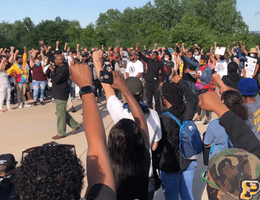
Protesters Gather at the Malcolm X Memorial Foundation on May 31, 2020
Photo by Chris Bowling | Flatwater Free Press
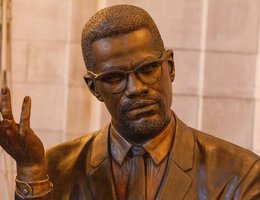
Nebraska Hall of Fame Bust of Malcolm X by Nathan Murray
Photo by Aaron Bonderson | Nebraska Public Media
Legacy in Nebraska
Nebraskan reactions to Malcolm X’s death were complex and varied. An obituary in the Omaha World-Herald referred to him as “the most violent Negro figure in the country” with an “insignificant” following. A more favorable obituary in the Omaha Star blamed White America for the climate that resulted in his death:
Malcolm X is our victim ... it will not do to condemn the violence which killed him, or the violence he espoused, until we have wiped out the misery and ignorance which produces violence.
Two of Omaha’s civil rights organizations sent condolences to the Shabazz family while publicly distancing themselves from his beliefs.
Between 1968 and 1997, Malcolm X’s birthday was observed with celebrations in Omaha, though these were rarely recognized by the city government. In 2024, the Nebraska Unicameral officially established Malcolm X’s birthday as a state holiday.
While the original Little home at 3448 Pinkney Street was demolished in 1965, Rowena Moore purchased the site in 1971 and founded the Malcolm X Memorial Foundation which honors “the human rights legacy of Malcolm X while prioritizing self-reliance & determination through radical movement building.” The site was listed in the National Register of Historic Places in 1984 and received a historic marker from the state of Nebraska in 1987.
In Nebraska and across the world, Malcolm X’s legacy has been invoked by people of many races resisting racial inequality, police violence, and dehumanization, especially within the ongoing Black Lives Matter movement.
In 2022, Malcolm X was selected as the 27th inductee to the Nebraska Hall of Fame. He is the first and, so far, only Black Nebraskan to be inducted.
What does the Hall of Fame induction of Malcolm X mean to Nebraskans?
Story by Aaron Bonderson | Nebraska Public Media (Transcript)
Updated April 22, 2026
Glossary
orator—a skilled public speaker
Great Migration—a movement of millions of Black Americans from the South into Northern cities that took place from the 1910s through the 1930s
Black Nationalism—a movement that advocates independence and self-governance for Black Americans. Rather than seeking integration into White society, Black Nationalists prioritize taking control of their own communities
Red Summer—the summer of 1919 when more than thirty American cities experienced lynchings and anti-Black race riots
Ku Klux Klan—a White-supremacist secret society that has existed in the United States since the Reconstruction Era. During the 1910s, the KKK began a period of growth and extended its terrorism to Catholics, Jews, and immigrants.
Great Depression—a worldwide economic crisis that began in 1929 and continued throughout the 1930s. Americans experienced high unemployment, low wages, and business failure.
draft—random selection of men for required service in the military. The United States began drafting men ages 18-45 for the Second World War in 1940. While men ages 18-25 are still registered, draft orders have not been issued since 1972.
Roaring 20s—the period from 1920 to 1929 when the United States experienced consistent economic growth. During this time, Harlem experienced a “Renaissance” (period of rebirth or renewal) in which it became a center for Black art, culture and scholarship.
racketeering—organized crime involving fraud or extortion such as illegal gambling, bootlegging, or sex trafficking.
Nation of Islam—a Black-Nationalist and religious organization founded by Wallace Fard Muhammad in 1930.
COINTELPRO—short for “Counter-Intelligence Program.” A secret operation by the Federal Bureau of Investigation under J. Edgar Hoover with the goals of monitoring, discrediting, and disrupting organizations that were deemed un-American. These included socialist, feminist, anti-war and civil rights organizations.
Sunni Islam—one of two major branches of Islam. More than eighty percent of the world’s Muslims identify as Sunni.
Hajj—an annual religious journey to the city of Mecca in Saudi Arabia. All Muslims who are able are required to make the Hajj at least once in their lifetimes.
Organization of Afro-American Unity—the organization founded by Malcolm X in 1964 with the goals of fighting for human rights and promoting cooperation between people of African descent in North and South America
Reflection Questions
- CONTINUITY AND CHANGE: In what ways did Malcolm X change throughout his life? In what ways did he stay the same?
- CONTEXTUALIZATION: How did the historical context Malcolm X lived in affect his attitudes and beliefs?
- MULTIPLE PERSPECTIVES: Why was Malcolm X such a divisive figure? What might have led different audiences to have dramatically different feelings about him?
- SIGNIFICANCE: In what ways are Malcolm X’s life and thought relevant or informative to American life today?
References
“About Us.” Malcolm X Memorial Foundation, n.d. Accessed October 29, 2025.
Bagwell, Orlando, dir. American Experience. S06 E07, “Malcolm X: Make It Plain.” Aired 1994, on PBS.
Bowling, Chris. “Malcolm X’s Omaha Roots.” Flatwater Free Press, September 8, 2024.
Bristow, David L. “Malcolm X in Omaha, 1964.” Nebraska State Historical Society, February 1, 2022.
DeCaro, Louis A. On the Side of My People: A Religious Life of Malcolm X. New York University Press, 1996.
Fletcher, Adam F.C. “A Biography of Malcolm X in Omaha.” North Omaha History, March 13, 2019.
—. “A History of Omaha’s Malcolm X Day.” North Omaha History, February 14, 2019.
Fletcher Sasse, Adam. “A History of the Ku Klux Klan in Omaha.” North Omaha History, July 31, 2023.
Frisbie, Al. “U.N. Is Goal of Malcolm X.” Omaha World-Herald (Omaha, NE), June 30, 1964.
Marable, Manning. Malcolm X: A Life of Reinvention. Penguin, 2011.
Natambu, Kofi. The Life and Work of Malcolm X. Alpha Books, 2002.
Omaha Star (Omaha, NE). “‘Negro Must Prepare to Defend Himself or Continue at the Mercy of Racist Mob.’” July 3, 1964.
Omaha World Herald (Omaha, NE). “Man of Violence.” February 23, 1965.
Parr, Patrick. Malcolm Before X. University of Massachusetts Press, 2024.
Payne, Les, and Tamara Payne. The Dead Are Arising: The Life of Malcolm X. Liveright, 2020.
Perry, Bruce. Malcolm: The Life of a Man Who Changed Black America. Station Hill, 1991.
Schuyler, Michael W. “The Ku Klux Klan in Nebraska, 1920-1930.” History Nebraska 66 (1985): 234–56.
Snodgrass, Duane. “Malcolm X Declares Anything Whites Do Blacks Can Do Better.” Omaha World-Herald (Omaha, NE), July 1, 1964.
Wallace, Mike, and Louis Lomax, prods. The Hate That Hate Produced. WNTA-TV, 1959.
X, Malcolm, and Alex Haley. The Autobiography of Malcolm X. One World, 1992.
Young, Whitney M. Jr. “Malcolm X, the Man Is Dead.” To Be Equal. Omaha Star (Omaha, NE), March 5, 1965.
About the author: Shane Adams is a K-12 Education Specialist at Nebraska Public Media and former high-school history teacher. He holds an M.A. in History and M.S. in Secondary Education from the University of Nebraska at Omaha.