


Nebraska's Red Scare
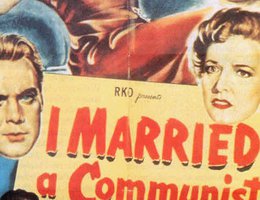
Promotional poster for "I Married a Communist", 1949; re-released in 1950 as "Woman on Pier 13"
Courtesy RKO Radio Pictures
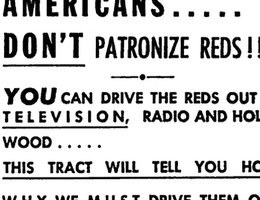
Typical U.S. anticommunist literature of the 1950s, specifically addressing the entertainment industry
Courtesy Wikimedia Commons
The Red Menace
The politics of the 1950s and early 60s were dominated by one central fact — the communists had changed from allies during WWII to sworn enemies during the Cold War. People were afraid that communists, or "reds," would take over America and the world, especially since they also had atomic weapons. For many, the Korean War was proof that communist regimes would try to expand their territory unless the West deterred and contained them.
In Congress, the two different committees, one in the House and one in the Senate, were revived to investigate the influence of communism on America. In the Senate, chairman Joseph McCarthy claimed to have lists of names of communists in various government departments. In Hollywood, suspected communists were put on a "black list" and found themselves out of work. Across the country, families built fallout shelters in their basements and thought about the unthinkable — how someone could survive an all-out atomic war. The idea of the Red Menace was especially forceful in Nebraska because we had the headquarters for the U.S. atomic war machine on our eastern border and dozens of atomic missiles across the state.
People believed that if we weren’t careful, communists could take over all parts of America, either by military means or by subverting Americans from within.
During the 40s, Russia was an ally fighting against Nazi Germany. During the Great Depression of the 1930s, the economy was so bad that some leaders thought that a communist system might help the suffering of the lower classes in the U.S.
During the 1950s, many people were looking for more conservative political programs. Many were bewildered by the threats that the atomic bomb brought to their lives. Many were less tolerant of different political ideas. Many wanted to return to "the good old days."
Those fears and anxieties had one focus — the Red Menace, Russia. Communism threatened to bring economic, political, and social chaos to a people who longed for stability. This was not the first time the Red Menace had played on people’s fears. Right after the Russian Revolution in 1917, some leaders in the union movement had experimented with communism. There had been a backlash against communism then, and there was again during the 50s.
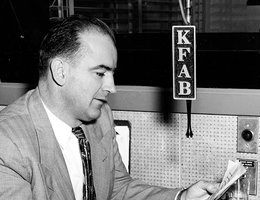
U.S. Senator Joseph McCarthy speaking over KFAB Radio in Lincoln, Nebraska, August 24, 1951
Courtesy History Nebraska, RG2608-1265
McCarthyism & his Trip to Nebraska
Across the country, Senator Joseph R. McCarthy of Wisconsin had become the most vocal hunter of communists within the U.S. government. He was an ambitious politician who seized on the growing fear of communism as his political crusade.
In February, 1950, McCarthy was slated to speak before the Republican Women’s Club in Wheeling, West Virginia. During the weeks before, China had fallen to the communists and Russia had tested an atomic bomb. Two years before, an official in the State Department, Alger Hiss, had been convicted of spying for the Russians, and a scientist on the U.S. atomic bomb project had confessed to giving the Russians atomic secrets. So, McCarthy had a receptive audience when he charged that there were communists within our own government who were working to subvert the U.S. He said:
"In my opinion, the [U.S.] State Department, which is one of the most important government departments, is thoroughly infested with Communists. I have in my hand 57 cases of individuals who would appear to be either card-carrying members or certainly loyal to the Communist Party, but who nevertheless are still helping to shape our foreign policy."
Early news stories of the speech reported that McCarthy claimed to have names of 205 communists in the State Department. McCarthy later claimed he said he had 57 names. Whatever the number, the charge got more attention than McCarthy could have hoped for. Newspapers across the country reported his charge that there were communists in the State Department. Later investigation dismissed all of these charges, but by then McCarthy was making new claims.
Two days after the Wheeling speech, McCarthy sent a telegram to President Harry S. Truman demanding that the President identify and fire the 57 communists. "Failure on your part will label the Democratic party of being the bed-fellow of inter-national communism," McCarthy wrote.
Truman wrote, but probably never sent, an angry response to McCarthy. He did go on the record talking to reporters a few days later, when he said bluntly, "I think the greatest asset the [Russian government] has is Senator McCarthy."
U.S. Senator Joseph McCathy’s Accusations & President Truman’s Response
McCarthy brought his anticommunist crusade to Lincoln on August 24, 1951, where he made a nationally broadcast radio speech from the studios of station KFAB. (KFAB started in Lincoln in 1926 and later moved to Omaha.) He continued to charge in the address that Democratic administration officials were either communist sympathizers, members of the American Communist Party, or outright Russian spies. But his methods — claiming to have a list of names, yet never providing hard evidence to back up his charges — had begun to come under fire. McCarthy fired back that anyone who opposed him was a communist. In his Lincoln radio address, he said, "Everyone who hates communism loves McCarthy. Everyone who loves communism hates McCarthy."
The next night, McCarthy spoke to a sparse crowd of less than 500 in Omaha. The Lincoln Star newspaper reported, "Senator Joseph R. McCarthy was in Omaha Monday night bleeding at every vein in his one-man crusade to make the world safe for free men. He said that he alone is the savior of human freedom." On its editorial page, the Star called McCarthy’s visit "August Madness", criticized his charges and methods, and hoped that the American people would not put up with "McCarthyism".
After four years of charges and countercharges, the U.S. Senate eventually condemned McCarthy for abusing his power as a senator. He died three years later of alcohol-related illnesses. But he had given voice to a powerful sense of fear that many Americans felt at the time. Nationwide, it’s estimated that as many as 12,000 people lost their jobs because of alleged communist associations.
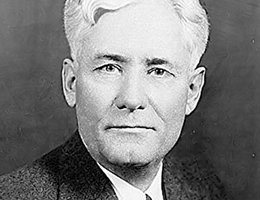
Nebraska Senator Hugh Butler; In 1950, supported McCarthy
Courtesy U.S. Congress
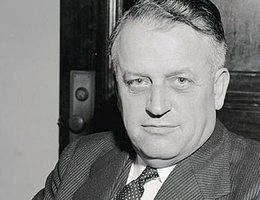
Nebraska Senator Kenneth Wherry; In 1950, supported McCarthy
Courtesy U.S. Congress
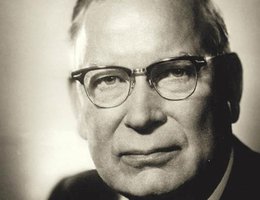
Nebraska Senator Roman Hruska; In 1954, supported McCarthy
Courtesy U.S. Congress
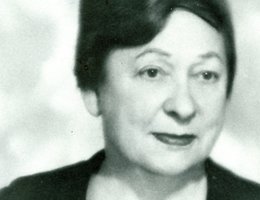
Nebraska Senator Hazel Abel; In 1954, voted to censure McCarthy
Courtesy U.S. Congress
Nebraska’s Response
Initially, most Nebraska politicians were cautious about voicing their opinions of Sen. McCarthy. However, in 1952, former Nebraska Governor Dwight Griswold said it was a "thrilling experience" to hear McCarthy speak in Chicago. He was particularly impressed when Senator McCarthy said, "There is no such thing as being a little disloyal." McCarthy’s ideas, if not his attacking style, hit a nerve, and legislative bodies tried to respond to the perceived threat.
In 1961, the Nebraska Judiciary Committee approved LB723, a proposal to outlaw the Communist Party in Nebraska. The bill stated that membership in any party advocating the overthrow of the government was a seditious (rebellious) act against the state. Anyone who was convicted was barred from any state job or "position of trust" on any level. The debate over the proposed ban was heated. Supporters argued that it was obvious that communists wanted to dominate America. One Senator from Arapaho said,
"If ever there was a time when America should rise up it is now. You can’t expect to meet this enemy in the open. They only operate through destructive underground channels. They are headed for your home and your town."
Nationally, in 1950, Nebraska Senator. Kenneth Wherry — who was the leader of Senate Republicans from 1949 to 1951 — and Senator Hugh Butler supported McCarthy. Much of their support was in response to years of frustration under the Democratic administrations of President Roosevelt. For McCarthy and others like Butler, the New Deal’s reforms, were tantamount to treason.
By 1954, the press and television reporters were questioning McCarthy’s claims of communist infiltration. Edward R. Murrow and CBS TV broadcast a program composed almost entirely of McCarthy’s own words and pictures. It showed the Senator browbeating witnesses and never producing evidence. It was a damning portrait of a fanatic. Many Senators were also tired of McCarthy’s unsupported allegations, and a resolution was introduced in the Senate to reprimand him. The vote was lopsided — 65 senators voted to censure McCarthy, and only 22 voted against the measure. Senators serving from Nebraska in 1954 split on the vote. Roman Hruska voted against the censure, while his fellow Republican Hazel Abel supported it.
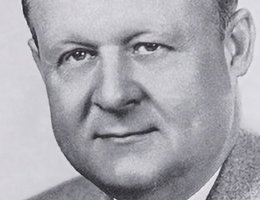
Governor Val Peterson, in the Cornhusker Yearbook, 1952
Courtesy University of Nebraska Libraries, Archives and Special Collections
The List of Nebraska Communists
In late 1950, Nebraska Governor Val Peterson told the press that he had compiled a list of suspected subversives, who were to be rounded up in the event of a national emergency. Peterson’s list supposedly named many suspected communists in Nebraska, but he told the State Defense Council, only one had a job working for the state. The Governor said it was his duty to defend the state.
Critics of Peterson’s action said the list had little practical significance and may have been a bit of grandstanding, or playing for political advantage. Others thought such a list could result in discrimination against individuals who never had a chance to defend themselves against allegations.
According to the FBI, there were fewer than 40 Communist Party members in the entire state. A March 26, 1951 Omaha World-Herald article said that FBI Chief J. Edgar Hoover had identified 35 communists living in Nebraska.
All of this fear of the "red menace" right here at home prompted local lawmakers to try to do something about it. In 1951, State Senator Walter J. "Lefty" Williams of Ravenna proposed a law requiring all communists in the state to register. But, the bill ran into trouble from the beginning. The Nebraska Attorney General had already ruled forcing communists to register was unconstitutional, but the parts of the bill that barred communists from public office or appearing on election ballots was constitutional. Ultimately, the bill failed to pass into law.
Even though no list of communists in Nebraska has ever been made public, the idea of such a list is still controversial. Peterson was later named the head of the Federal Civil Defense Administration (FCDA) and was instrumental in setting up plans designed to help civilians survive a nuclear war. As recently as April of 1995, the World-Herald defended Peterson’s compilation of suspected subversives as a prudent step.
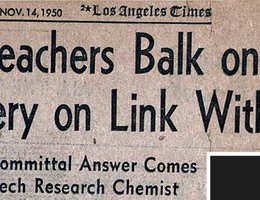
Newspaper headline about California teachers who didn’t want to take a loyalty oath, November 14, 1950
Courtesy Los Angeles Times
Nebraska’s Loyalty Oath
In an attempt to ensure the patriotism of their employees, many cities and states enacted "loyalty legislation" during the late 1940s and early 1950s. Nebraska followed the example of many other states and passed a loyalty oath law that went into effect in August, 1951.
The law required all state employees to sign a loyalty oath in order to keep their jobs. That included teachers and staff in public schools and at the state university and state colleges. The oath said that the signer did not advocate the overthrow of the U.S. government or belong to any political party or organization that did. The law said anyone who lied when they signed the oath would be fired and could not hold any other job paid for by public, or tax, funds.
The law singled out teachers, and the greatest opposition to the oath came from university professors who were concerned about their academic freedom. Some professors felt that in order to teach effectively, they needed to be free to raise questions about our system of government. They were afraid that if they presented the arguments for a communist system — as a way of highlighting the differences between the two systems — they could be fired.
In response to the new law, the University of Nebraska Board of Regents said that, "Communism was not present at the university, and if any [communism] were found they [the Regents] would eradicate it."
Nationally, there were efforts to extend the loyalty oath process to students. The federal government decided that students applying for federal student loan programs would have to sign a loyalty oath. Some colleges across the country protested and refused to accept federal funds for student loans because of that requirement. At first, the University of Nebraska did accept the loans and the loyalty oath. But, eventually, professors passed a resolution opposing the oath provision. A growing number of colleges were protesting, and so President Eisenhower recommended that the oath be repealed.
As the years went on, Nebraska’s law was generating more and more questions about how it should be administered. There were questions about what really were "public funds" and therefore exactly what jobs did the law actually apply to. There were questions from the state Attorney General in 1951 about how to enforce the law. The way the law was written, no one could actually be sent to jail for violating it.
But despite the questions, the law remained in force up until the late 1960s when a secretary in the Department of Philosophy at the University sued after being fired for not signing the oath. The law was finally declared unconstitutional in 1967.
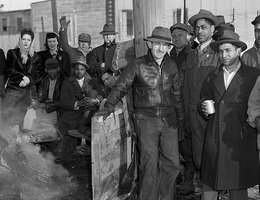
Striking Armour Co. packinghouse workers try to keep warm in south Omaha, 1948
Courtesy History Nebraska, RG2608-1265
Organized Labor & the Red Scare
The fear of communism also affected the labor union movement in Nebraska during the 1950s. In the early 1900s, some national unions, like the IWW, Industrial Workers of the World, had adopted communists ideals in struggling to get better pay and working conditions. And so, during the Red Scare of the 50s, many assumed that unions would be full of communists who would disrupt national and local economies by encouraging strikes and violence against large companies.
In fact, Nebraska unions were already weak and probably contained few who adopted communist ideals. Nebraska unions did receive a small boost during World War II as more workers were needed, but memberships fell back after the war ended. And in 1946, Nebraska voters approved a "Right to Work" constitutional amendment by a vote of 212,443 to 142,702. The amendment and related laws said that any worker could refuse to join a union and refuse to pay dues or fees associated with bargaining efforts, even if the bargaining resulted in better wages for all workers at the company. Supporters of the act said it would make it more difficult for communists to infiltrate union organizations and use them as a vehicle for disrupting the economic and political stability of Nebraska.
One industry that was organized was the packinghouse district in south Omaha, and packinghouse workers called a series of strikes during the late 40s. The "Red Scare" was raised during a particularly divisive strike in 1948. The Omaha World-Herald ran a series of articles on local communism around this time. Harold Anderson wrote an article on January 27, 1949, titled "Red Minority Won Rule of Omaha Union." The article quoted Patrick Ratigan, a key figure in a 1946 strike against the packinghouses in Omaha. Ratigan had been fired as a United Packinghouse Workers of America (UPWA) representative. He contended that the reason he left UPWA was because its leadership refused to sign the non-communist loyalty oaths required under the Taft-Hartley Act. Yet, the parent union of the packinghouse workers, the Congress of Industrial Organization (CIO), were often out-spoken opponents to communism.